My practice of journaling
Dear Tanya,
Thanks for you interest and calling me out. Put up or shut up, right. Indeed as Omar says in he Wire, “A man gotta have a code.” Omar also said, “All in the game, yo” Or as I think of it, the practice. Folk gotta have a practice. What I am going to do is chip off a piece of my practice and share it with you. Just be clear: this is my practice and you must be prepared to create your own. Maybe this is why most of us don’t ‘keep on’. We try to adopt someone else’s practice whole hog and in the parlance of the kids—that don’t hit. All can say is that until I finally said, ‘fuck it, ya know’ and just accepted the
full blown imperfection and oft-times catastrophe of my own practice, I had no practice.
Write
One of the best books on writing is not about writing per se. It was written by Benjamin and Rosamund Stone, “The Art of Possibility”. Benjamin is a conductor and Rosamund is a teacher. I bring them up at this juncture becauseI have always struggled with finding a time and place to gather my orchestra for rehearsal/practice. Every chapter in their bookconcludes with a practice. The first one the classic 9 dot problem. “All in the game, yo”
The story we tell ourselves is in that classic brain teaser is that you can’t cross through all nine dots with four lines. It’s true. You can’t. So we ask what is next? How can we do it? It is a very difficult practice, but I managed to do it and you can, too: redefine your constraints.
Why is this hard? Our minds are habit loving. They see the nine dots and they see a box with a dot in the middle. We are awash with box figures in our lives, our metaphors and our worldly schema. If you can look instead at the space that surrounds the box, you might realize that you can use ALL that page space to solve the problem. No one told you not to, did they?
I am probably not telling you anything you don’t already know, but that’s why this is such a devil dog of a problem. The constraints are with us always even when we see the solution drawn for us. Habitual schema like boxes are iron bands that are so hard to break. Zander calls it a coffin.
I always believed in the rule that you apply you ass firmly to chair. Yeah, that didn’t work. More like sports writer Red Smith’s admonition to apply ass to chair, cut wrists, and bleed through the keyboard. So what I do is pretty simple and has an organic rather than a templatish, outliny feel to it.
First, I created a very simple Google form with a date and a text field as well. I stole Matthew Dicks’ idea of Homework4Life with this question: Storyholder? (What was the most storyworthy moment from my day NO MATTER WHAT?)
Second, what next? What if you don’t have a storyworthy moment. Dicks emphasizes the “no matter what” point pretty clearly as do I. And the Zanders have their own phrase, “it’s all invented”o be kind to yourself as you note your storyworthy moment for the day in the morning.
I keep this Google Form open all day. I also keep a small daybook of some kind with me all day. I have been doing that for years (bad short-term memory, dontcha know) but now I take those notes the next morning and populate the Google Form with them, priming the memory pump.
Write with Holy Detail
Your life is holy. Like mine it might be a holy mess, but by God it is our own. It is full of detail and your record of it should be detailed. I am a poet so I am a firm believer in what the French call “le mot juste” and what I translate as “just the right word”. Who makes this artistic judgment? You do. This point returns to one I made earlier: you gotta have a code. I think what I want you to do is realize, deep down, that any mark you make, no matter how small or playful is journal-worthy and a hioly detail. It is telling. It’s all a holy mess
This is where I steal prolifically from others. For example, I am using a Gary Snyder poem, “January” as a template for some holy details of my own. Or I borrow from someone like Ted Hughes and use his essays from “Poetry in the Making” as prompts for writing my own holy details. Or I do my molasses slow reading from Marc Hamer’s magnificent and detail-holy book, “A Life in Nature: or How to Catch a Mole” as my own fodder. I took a paragraph from that book, stripped out his detail and re-filled it with mine. The line that sings in that poem was originally, “picking greens in the garden in the dark”. I filled it with holy details for good or ill this way, “picking lettuce and pepper and cilantro by starlight”.
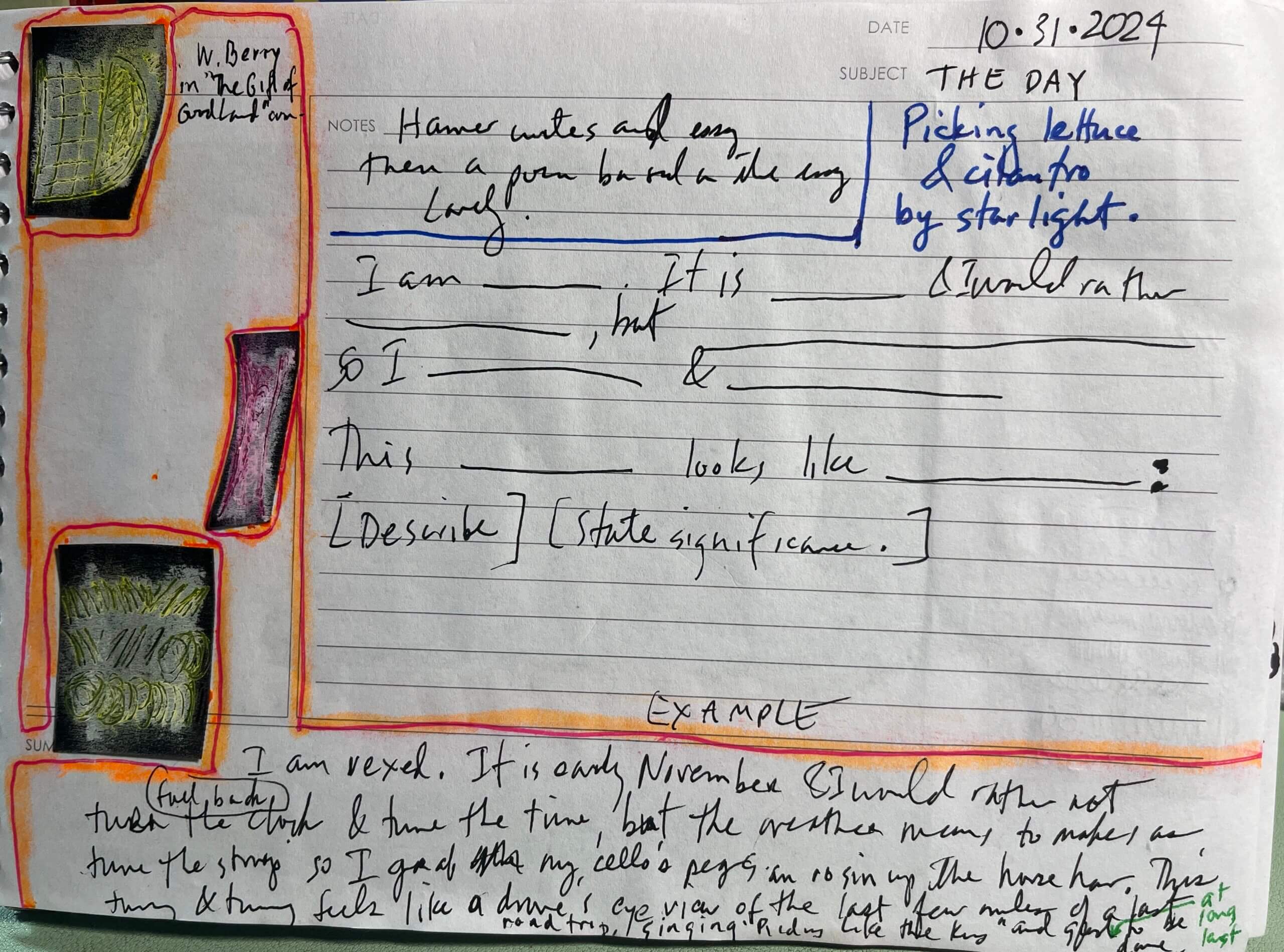
My point here is to reiterate that journaling is all about your choices. You build your practice your way. If you miss a day or a few or a week, no fret. But be aware if you miss a month it is probably because you have not understood for yourself that it’s all invented and you have created a box for yourself that was never there. The solution to the nine dot problem for journaling might just be that you have forgotten that the whole page is yours: write big or write small or draw or paint your solution. Matters not. It’s all storyworthy.
Tools
One of the brain-deep joys of journaling is that it is analog and digital and whatever that crossover thing is that is both. I seek and receive signals from the world mostly in a digital form. For example, I have an RSS newsfeed I access every day. I have newsletters I subscribe to that I read in Gmail. I have YouTube channels. The full catastrophe, b limited and limiting, an example of the constraint I mentioned previously. I need the haptic, the tactile feedback that comes from good paper and ink and pens.
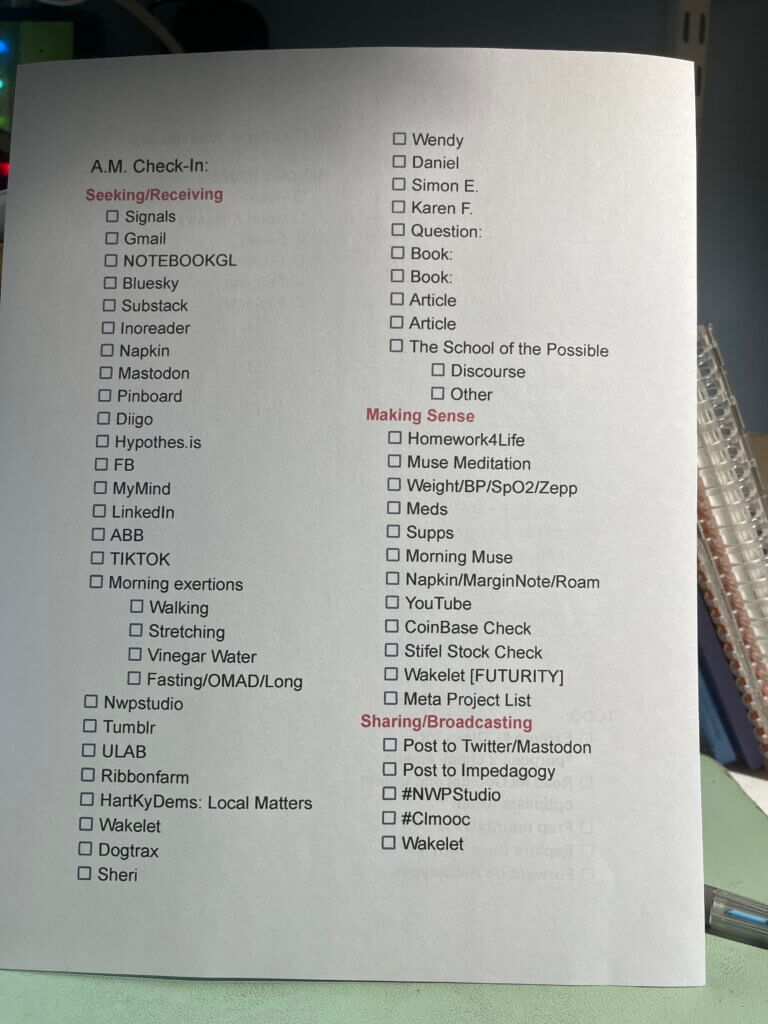
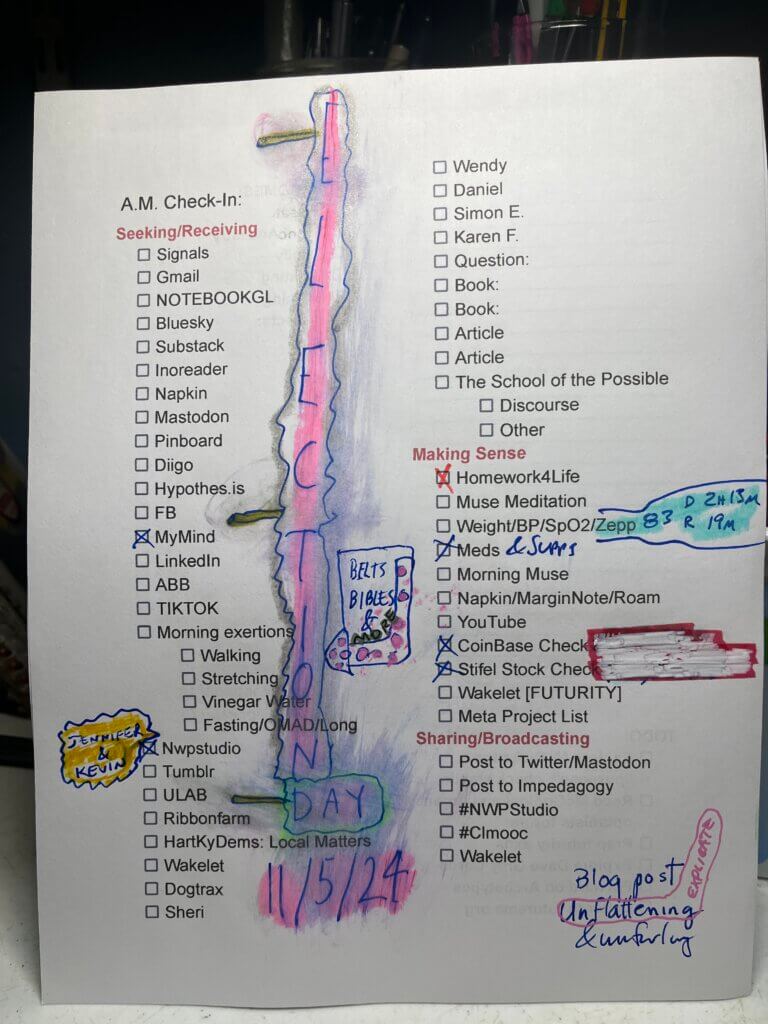
My writing practice is woven my morning check-in. I print out a checklist of activities I want to do. Of course, there is too much, but the first one on my A.M. Check-In is Homework4LIfe. If I am not up to that right away I record my sleep score and my oxygen level and my blood pressure. I also take meds and supps as well. Check. Usually ticking off tasks give me some inertia to do the Homework4Life.
At this point I begin to wrangle my personal learning network where I have three categories: seeking/receiving, making sense, and sharing/broadcasting. Most mornings I am looking for signals from the emerging future, some long term and others middle or short term. I share via my blogs (Impedagogy, Substack), X, bluesky, mastodon, inoreader, tiktok and #nwpstudio. I don’t get to everything on my Check-In, but it stands as a reminder of my larger purpose of sharing online.
I wander back and forth between the analog and digital using good tools in both realms.
Answers just for Tanya (but anyone may read them.)
I want to know WHY YOU journal: I believe I live an interesting life with an audience of one at least. I am pretty sure that the game is worth the candle. The journaling is part of the wheel of creation in my life. It feeds a part of me that is worth noting and observing.
I want to know when/how: I journal in the morning, but I also keep daybooks where I note what seems noteworthy and storyworthy. I have a wider definition of what constitutes journaling and a deeper feel for its significance and for the signals it helps me suss out. It has been very therapeutic of late since my wife visited our daughter in New Zealand and I spent a lot of alone time. I tried to explain how I do it above. Happy to share a Zoom session with folks if you want more, but I think that you have a better system within you that I could learn from.
I want to know if you have stops and starts or a pretty steady practice:
y tempo is regular. I use my A.M. Check-In daily. Some days I check a lot, others not so much. I make it a practice every day to use my daybooks and to record at least some of what is in there inside Homework4LIfe.
I want to know how journaling makes you feel/helps you in the world:
I have issues with getting irritated. I suspect I am bipolar, but men of my generation don’t usually do anything about that other than keep on. My practice staves off the dark dog I think. Just wish I had better sleep. I wish I could give more of myself over to this work. I am inspired by the enlarged possibilities in doing research as well as the profundity of AI tools and attitudes. If I had more energy in the evenings I would love to go online and chat with folks about AI. I think journaling is a tool for discovery and reflection. The more that journaling is like scrapbooking, the better for me. I love color on the page. I love calligraphy. Everything rolls into this including big thinkers like Dave Gray, Nick Sousanis, Lynda Berry, and Sunni Brown
And now I want to know if/how you live by that William Morris quote. I have it posted in my house, but I still am surrounded by more than I want/need (so if that could be a bonus session, excellent 💙)
How many lumens does anyone need?
How much is enough?
Most assuredly we have enough junk to crush the planet
or at least the whales.
I try to live by that Morris quote,
but don’t ask me how many poems
I need to have written before I call it done.
I am yearning toward the useful
and like them I am not quite beautiful…
yet.
And you?
Permalink //
Well, I feel like I won the lottery. A whole blog post that starts “Dear Tanya”, quotes Omar, has a friend older than me freely use the phrase “that don’t hit,” offers advice, and examples (in color no less).
So, what do I do? I read, I note, I think maybe I should come back to that, I don’t. . . In the next few days I’ll put a more full response (complete with photos) into the studio.
Thank you 🙂
Permalink //
Delightful.
Permalink //
oh, and yes, next month, or in January, but I think better next month, let’s host a live session about journaling in the studio and see who else might want to talk to us.
Permalink //
I am up for that.
Permalink //
Terry, I first saw this post on your Substack. You’ve developed a comprehensive habit for your journaling and as with other things you’ve learned, you’re freely sharing it. I hope Tanya and others find tips they can build into their own practices.
A few weeks ago another friend on social media pointed me to Dave Winer, who has been writing his blog for 30 years. Until now, our paths had not crossed. Have you found his work?
Permalink //
One of the first blog tools I used was a piece of blogging software called “RadioUserland” that was written by Dave Winer AND he pretty much invented RSS feeds. So, yes, he da man.
Permalink //
Fascinated by your checklist reminders, and happy Tanya found the note.
Kevin
Permalink //
Me, too. I tend to get a little strung out and forget where I have been and where I am blazing. “Now…where was I?” is a common plaint across my whispering lips.