
I am reading and listening to Maria Konnikova’s, “The Biggest Bluff: How I Learned to Pay Attention, Take Control, Master Myself and Win”. Every once in a while I am struck as I read by the crossover potential of one discipline within another. In this case, her pursuit of professional poker seems so apt for anyone who wants to teach themselves or others.
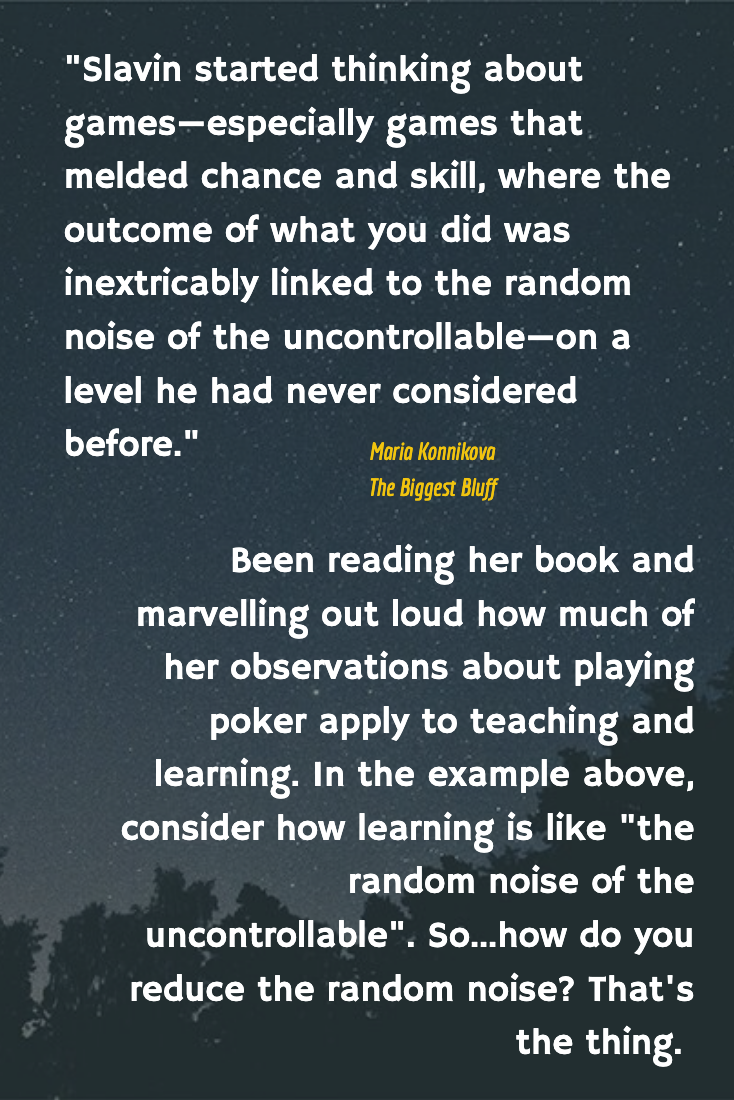
The image below shows how I am thinking out loud on this crossover so anyone can see why I feel this way about Konnikova’s work.
I, also, want to note that as I wrote above, I am listening to her book as I read. I do this on occasion for parts of books because it slows me down to “consideration speed”. That would be sloooooooow. But please note that as a reader when I start reading the book is mine. I can stop listening at any point and take up the dual reading/listening combo at any time. Or I could just listen. Or I could start annotating. Or I can share in ways that reveal my thinking out loud.
This particular quote re-contextualized into my teaching and learning work makes me reconsider how learning has always seemed so much like the luck of the gaming table and often more a function of the zip code you happened to be born into more than any capacity or tenacity you might exercise. You might say that agency is often overrated? I think, too, that teachers are blindsided by the assumption that if they design the learning environment more perfectly and efficiently that students will learn more. Pure hubris. I am struck more and more by Rudyard Kipling’s Stoic anthem/poem, “If…”. It has become a bit hackneyed for me since I first read it fifty years ago in high school, but viewed through the filter of Konnikova’s text I can see how useful it might be to re-read and re-listen to it and keep it handy, especially Dennis Hopper’s recited on “The Johnny Cash Show”.

And here’s another version reinterpreted for women.
Permalink //
I like your idea of filtering a ‘familiar’ text through a new thought from another discipline to reduce nose. I’ve been reading about diffractuve reading and I think this is an example of that.