
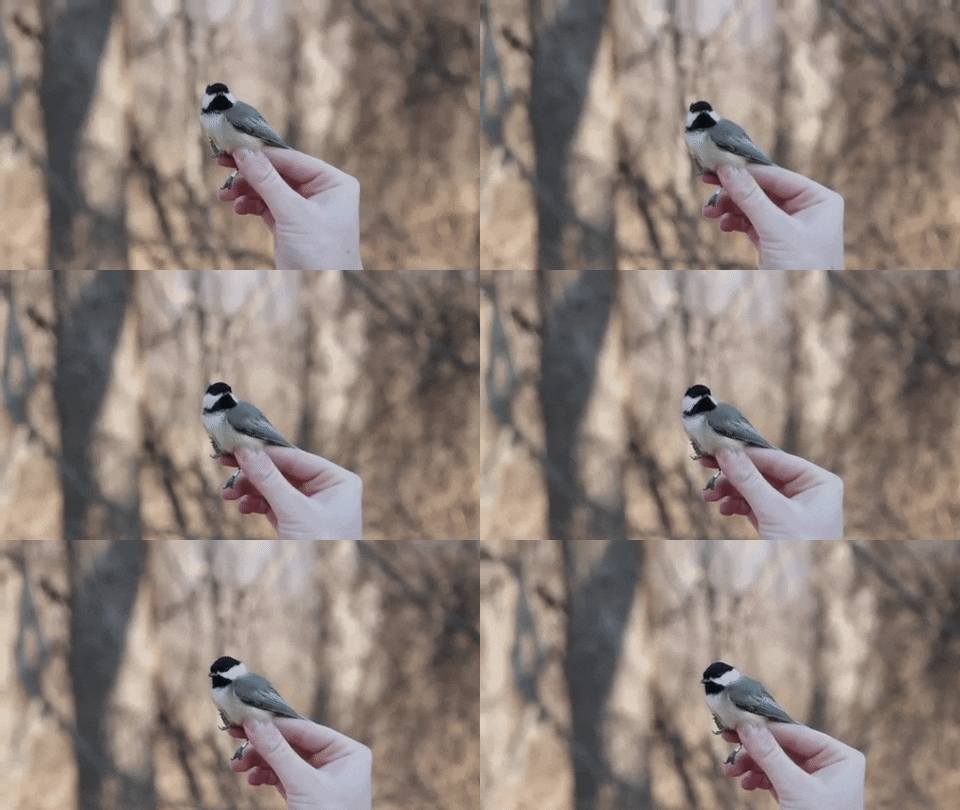
We both heard the characteristic whump on the windowpane. A bird hit the window. My wife beat me to it so as to keep the cats from eating the stunned little thing–a chickadee. She held it in her hands, warming and calming it until it seemed ready to fly. She took it outside, put it in a protected thatch of browned hummingbird vine and walked away. I watched it for about five minutes. It responded to my tapping finger on the glass, turning its black capped head, but it did not fly away.
I grew distracted and forgot about it until the next morning. The weather had turned a bit of a fright–15 F and 10 mph winds. I looked to where the chickadee had been perched. No bird. I walked out the back door to scan the ground to see if it had not survived. No bird.
A question unbidden flitted in: is absence of evidence, evidence of absence? In other words, is it possible to prove a negative, possible to prove that the chickadee no longer exists?
It is not a trivial question. In times like these I need to know the chickadee lives. In fact, absent the possibility of proof, I think belief is the only substitute.
I believe the chickadee survived the blow to the window.
I believe that I will be able to hug my granddaughter again.
I believe that we will be able to visit my son and his wife again for dinner.
I believe that I will join our daughters digging in our garden for sweet potatoes.
And so much more because I am homo fidelis, man the believer.
Absence of evidence cannot be evidence of absence.
Permalink //
Belief in things we cannot know for sure is a trait of humans. But are we alone with that?
What of “instinct” that causes birds and animals to migrate, often thousands of miles? Is that a form of belief?
Not something I’m going to spend a lot of time on this coming year. However, “belief” without proof or solid evidence is something that I have dealt with for many years. For instance, based on what I’ve seen in the tutor/mentor programs I’ve led, I “believe” in the value of these programs. Yet, since the 1990s donors have asked for solid evidence, based on comparison research with control groups. Not being able to provide such evidence I’ve often lost funding.
Yet, in 2020 I’m connected to youth who were in my programs in the 1990s and earlier. They keep telling me of the value we offered and I see it as they are sharing photos of their own kids finishing high school and college. I ask people to “believe” in the value and support such programs.
On the other hand we have a President who encourages the sharing of false information, encouraging “belief” of his narrative, without evidence to prove it.
What to believe? What not to believe”
Permalink //
All of the beliefs I cite are, as Dickens named in “A Christmas Carol”, of Christmases yet to come. They are what Otto Scharmer calls “presencing” or perhaps you are familiar with feedforward. They are emergent futures and all about sensing what wants to emerge. They are not reactionary (I hope). They don’t rely on what has already happened but they do rely on exploring the margins of our own selves and our systems because, just like a root hair, that is where the growth is. I see that in what you say. I think the next step for you might be telling some mentor stories. Or maybe you already have and I just haven’t found them on your site yet. If so, then it might be time to enlist others in radiating those stories. They might just end up being lighthouses of solidarity and strength in the face of danger.