
Clark Quinn in a recent Learnlet post, remarks on Myra Roldan‘s #MyraMonday question list on Twitter. He notes first that this past week, “the question was particularly interesting: about what you’d do if there weren’t elearning.”
Roldan’s response was that she would be exploring “escape rooms for learning”. Other related suggestions poured in from one of her personal learning networks, #MyraMonday on Twitter:
surprise box,
host a murder,
scavenger hunt,
choose your own adventure…Lots of infographics and cryptograms
comics
murder mystery party would be some Live Action Role-Playing (LARP) activity that includes instructions
Book ciphers
Red / Blue filters (look through a colored lens to reveal a hidden message)
Tune into a custom radio frequency that repeats a message
Text messages to a secret contact (a.k.a. Phone a friend)
I love how Roldan puts this question to her network. I will be following her #MyraMonday questions and perhaps steal her idea for #TellioTuesday.
I do the same thing below in parenthesis. Help me, please, and I will happily reciprocate.
(My ask: If anyone is interested in what I would be doing if not here, it would be this: memorizing sonnets and villanelles. Related suggestions? May be tangentially related if needed.\ )
The second observation Quinn makes is both deep and relevant:
There is a follow up on this: why aren’t we doing these things already? We should be looking at other mechanisms.
We can, and should, be looking at activities ‘beyond the course’. There’re the benefits of novelty, but also different affordances. Better yet, we could theme them to align with particular courses. There is a real opportunity to make our learning stick better, and that is the real bottom line.
Quinn recommends this kind of systematic creativity noting that it is not an oxymoron. Agreed.
My takeaway (and I am hoping yours, too) is that we should be asking ourselves why this isn’t an established mental schema habituated into our mental ‘choose your own adventure’ decision trees. Why don’t we automatically look for activities that we would be doing were it not for the ones we were already doing in the classroom or more generally at work?
Another way to look at this might be: what are the opportunity costs for doing anything anywhere anytime? Should this be a part of every class, every work space, every decision made? Yes. It doesn’t take much time to do and it is a way of ensuring we keep our best selves informed and in the decision loop. As teachers we don’t always do that do we?
In my case, I could be memorizing beautiful things and banking those poems for the day when I don’t have a book handy or the internet is down and not likely to be up or maybe from when I am too blind to read and perhaps too demented to remember anything else, but the powerful rhythms of pentameter. Viewed this way, the opportunity costs for not going ‘beyond the course’ are quite high.
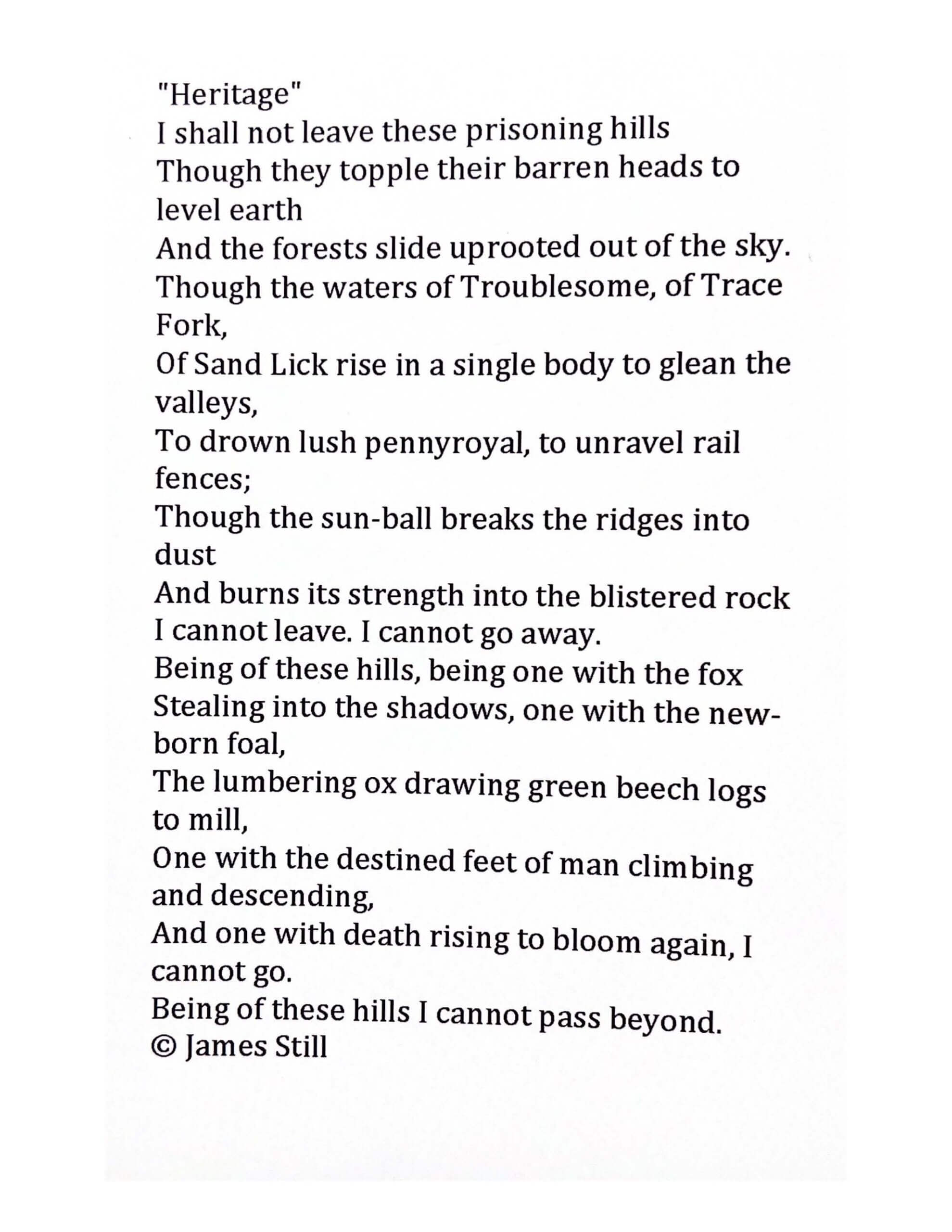
| I shall not leave these prisoning hills Though they topple their barren heads to level earth And the forests slide uprooted out of the sky. Though the waters of Troublesome, of Trace Fork, Of Sand Lick rise in a single body to glean the valleys, To drown lush pennyroyal, to unravel rail fences; Though the sun-ball breaks the ridges into dust And burns its strength into the blistered rock I cannot leave. I cannot go away. Being of these hills, being one with the fox Stealing into the shadows, one with the new-born foal, The lumbering ox drawing green beech logs to mill, One with the destined feet of man climbing and descending, And one with death rising to bloom again, I cannot go. Being of these hills I cannot pass beyond. |
Here’s a jpeg version if you want to print it out and memorize it:
Permalink //
Thanks for the link to Clark Quinn’s blog. I added it to my Inoreader library.
I think what’s missing from Quinn’s article and list is “focus”. What is it you want to learn about? That’s what prompts me to click into some articles on my Twitter feed, rather than others. It’s a curiosity to know more about some things, or about things I’m passionate about.
I focus on “adult learning” not just youth learning. Furthermore I focus on applied learning, as in “what more could I know about an issue that would help me find solutions or better ways to do something.”
The recent shooting in Highland Park has increased conversation about gun violence. NY Times did a story showing neighborhoods of high violence. I responded saying that while “guns” are a common denominator, the root causes are vastly different. People would need to dig very deep to understand why I think this.
A learning project could encourage such deeper learning.
As for ways to motivate learners, I outlined a youth visualization project on my wiki, where on-going prompts and rewards would stimulate learning about specific topics. You can read it at http://tutormentorinstitute.wikidot.com/youth-visualization-strategy
Many high schools and colleges do something like this now, using capstone projects to stimulate independent learning and problem solving around a variety of topics. However, I’ve not found any that focus on one or more specific topics in on-going, year-to-year student learning projects. Or that attempt to engage alumni in the learning and the solutions.
In conclusion I find many brilliant writers posting ideas in the abstract, but few who show those ideas in on-going, real-world, applications.
Thanks again for prompting my curiosity and this response.
Permalink //
Check the Hypothes.is margins. I am meeting there, a murder of crows dontcha know.
Permalink //
Maybe helpful for you: https://quizlet.com/186381551/shakespears-sonnets-to-memorize-flash-cards/
🙂
Permalink //
Thanks, Kevin, for dropping by. First my fellow Kentuckian and then my Elizabethan brother.