
I am swamped and I am reading how others are swamped. I am tempted to call this cognitive dissonance, but I don’t think that concept catches or carries the embodiment that is #rhizo14. Instead, I have been trying to process just like Agent J in MIB:

This morning I remembered. I had been in this neighborhood before. How could I have forgotten? What I remembered was an astonishing blog post by one of my favorite web iconoclasts, Venkatesh Rao. I have been dogging his blog, ribbonfarm, for many years. I have been slowing reading and re-reading his book Tempo for almost as long. What I remembered was his take on James C. Scott’s concept of ‘legibility’. Scott argues that the state in order to carry forth its institutional imperatives (taxation, for example) takes complexity either in nature or in society and reduces it to counable and manageable chunks. The picture below speaks volumes more than I could.
 (“A Big Little Idea Called Legibility.” Web. 22 Jan. 2014.)
Rao uses an example from Stephen Johnson to elaborate on the concept:
In Mind Wide Open, Steven Johnson’s entertaining story of his experiences subjecting himself to all sorts of medical scanning technologies, he describes his experience with getting an fMRI scan. Johnson tells the researcher that perhaps they should start by examining his brain’s baseline reaction to meaningless stimuli. He naively suggests a white-noise pattern as the right starter image. The researcher patiently informs him that subjects’ brains tend to go crazy when a white noise (high Shannon entropy) pattern is presented. The brain goes nuts trying to find order in the chaos. Instead, the researcher says, they usually start with something like a black-and-white checkerboard pattern.
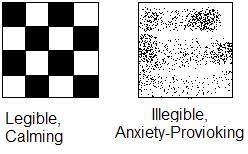
Rhizomatic learning invokes the illegible, the complex, and the organic. It is not so much uncomfortable so much as it irreconcileable. Rao sums up, “it is easier to comprehend the whole by walking among the trees, absorbing the gestalt, and becoming a holographic/fractal part of the forest, than by hovering above it.” It isn’t that we can’t see the forest for the trees. It is that we can’t become the forest when we make the trees legible. In this sense many of the current attempts to make learning legible are doomed to complete or nearly complete failure. The messified feelings we get from rhizomatic learning arise not from the process but rather from an attempt to demystify and order/control/guide the process . We say to ourselves (or at least I have said to myself), “How can I use this in my classroom, my professional life, my life?”
We likely can’t in the normal, transactional sense. Rhizomatic learning is a sample of one. And then another. Our attempts to generalize beyond that might be doomed to the same failure that curriculum planners often come to when they textbook-ify a discipline. That is not just an uncomfortable feeling for some. That is terrifying for some. For me it isn’t about letting go, for me it is about letting come. I must let the forest come, let the gestalt arise, let the zeitgeist form. [Insert any words here because mine fail.] As always, I could be wrong.

Permalink //
Van Lier (2000, p.260) tells us that ‘perhaps, after all, we ‘learn’ language in the same way that an animal ‘learns’ the forest, or a plant ‘learns’ the soil .’
Nurture diverse eco-systems.
Permalink //
Nature abhors a monoculture yet everywhere humanity strives to create legibility. When Thoreau said, “Simplify, simplify, simplify.” he never meant to reduce nature to a simple subset of human language. He meant that we should be rhizomatic, immersed and wandering in it all. Fewer filters, more “noise”.
Permalink //
My problem with Thoreau is that he was cheating all the time.
Living in the so called wild, he bought his farm, had others do the ploughing, went for dinner to his sister’s frequently, etc.
Aren’t many who claim the return to nature cheating too?
Permalink //
I would rather have a cheating Thoreau writing as best he could in contradiction than a Thoreau who never wrote a word.
Permalink //
Terry
Your words of “I must let the forest come” seems apt, and I agree, that flow of learning and words and conversations and more can easily overwhelm. I was thinking again of our work moderating Twitter Chats (since Troy and I did one this week) and I was trying to explain to my skeptical wife the value of the flow of ideas, some of which I never saw or absorbed. And how that was OK.
We’re out here with nets, scooping up some words and media and ideas, and letting others go, hoping we don’t kill manatees in the process. But when we discover something rich in the net, it’s worth the time and effort.
Kevin
Permalink //
I think that rhizomatic learning is like an unmoderated Twitter Chat. It is like the whole ocean. It might even be Gaia. I think what I want to learn is how to move back and forth with using the net and being the ocean. That is the kind of self-remediation I want to be capable. We mediate ourselves with more than language. We have a world of intermediaries and like the proverbial hammer-centered man, everything begins to look like a nail after awhile. I want to not be that man. Please.
Permalink //
Lol on being agent J, I think that’s what’s happening to me too for the past few days.
It’s still hard to understand all this, but I like that you mentioned the analogy of the forest. 🙂
Permalink //
I am so glad you mention the MIB reference. That particular quote sings like a power line in sub-zero for me. The legible/illegible concept is almost as opaque as rhizomatic/arboreal. Almost. I want to connect them in one really cool hand of bridge.
Permalink //
Whereas we can observe rhizomatic learning in ourselves on the web, on twitter, on blogs etc everyday, there still is no rhizopedagogy.
Letting go of goals and let students learn freely what ever they want to (or maybe they don’t want to learn and just want to leave) is only very partially possible in most of our societies.
To me rhizomatic teaching, if such isn’t a contradictio in terminis, comes closes to the indigenous ways of teaching of First Nations.
When the learner isn’t ready, there’s no role for the teacher.
Just wait until the learner gets there.
Do we still have that patience?
Permalink //
Thanks for calling new attention to this article with today’s Tweet.
Kevin wrote: “We’re out here with nets, scooping up some words and media and ideas, and letting others go, hoping we don’t kill manatees in the process. But when we discover something rich in the net, it’s worth the time and effort.”
Then Ronald wrote: “When the learner isn’t ready, there’s no role for the teacher.
Just wait until the learner gets there.”
The role of the mentor is to help draw the learner into the net, providing lures and encouragements that entice her to become curious, interested in some topic, which opens a door to learning.
The teacher can be the mentor. He is also waiting to support the learner as she comes through that door.
Permalink //
Yes, grasshopper: A monk asked Master Haryo, “What is the way?”
Haryo said, “An open-eyed man falling into the well.”
I suspect you are the either the open-eyed man…or the well…or the way. I say this as I plummet alongside you.
Permalink //
In college I wrote a poem talking about how most people go through life as though walking on a sidewalk and trying to not step on the cracks. When they get to the end of their lives they look back and all they see is a narrowing path leading to a tunnel of darkness.
My message was to forget the cracks, and the sidewalk. Walk with your head up and your eyes open. Looking back at the end of a lifetime will disclose a rich mosaic of experiences, few of which you could have predicted as you started your journey.