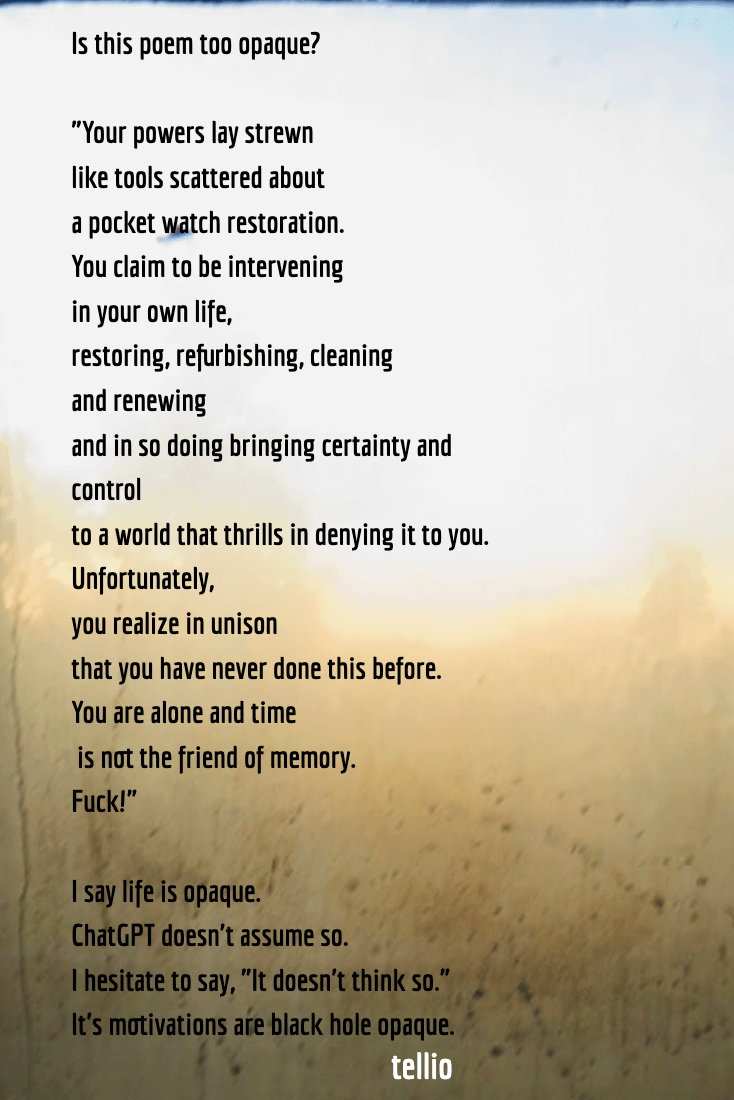
Here is a poem I wrote along with a chat that asked this: please explain this poem from the stance of a rhizomatic learner.
Your powers lay strewn
like tools
scattered about
a pocket watch restoration.
You claim to be intervening
in your own life,
restoring,
refurbishing,
cleaning and renewing
and in so doing
bringing certainty
and control
to a world that thrills
in denying it to you.
Unfortunately,
you realize
In unison
that you have never done this before.
You are alone
and time
is not the friend
of memory.
Fuck!
ChatGPT:
From the perspective of a rhizomatic learner, this poem can be understood as a reflection on the complex and interconnected nature of learning and personal growth. Rhizomatic learning is a concept that emphasizes the non-linear and decentralized nature of knowledge acquisition, where learning occurs through a network of interconnected ideas and experiences.
In this poem, the scattered tools and the act of restoring a pocket watch can be seen as metaphors for the various abilities, skills, and knowledge that the speaker possesses but has not yet fully utilized or integrated into their life. The scattered tools represent the fragmented nature of their potential, waiting to be harnessed.
The speaker claims to be intervening in their own life, seeking to restore, refurbish, clean, and renew. These actions symbolize the speaker’s desire to actively engage with their own personal growth and development. By doing so, they aim to bring certainty and control to a world that seems to take pleasure in denying them these qualities. This reflects the struggle of the learner who seeks to navigate a world that often seems resistant to change or self-improvement.
However, the poem takes a poignant turn when the speaker realizes, “that you have never done this before.” This moment of self-awareness signifies the speaker’s acknowledgment that despite their intentions, they are entering unfamiliar territory. It highlights the recognition that true growth and learning often involve venturing into the unknown and embracing uncertainty.
The final lines, “You are alone / and time / is not the friend / of memory. / Fuck!” capture a sense of frustration and perhaps even a moment of despair. As a rhizomatic learner, the individual understands that learning is a dynamic and ongoing process, and memory can be unreliable. The line “time is not the friend of memory” suggests that the passage of time can erode or distort one’s recollections and knowledge.
In this interpretation, the poem reflects the challenges and complexities of learning and personal growth. It highlights the rhizomatic nature of knowledge acquisition, where the individual’s powers and abilities are scattered and must be actively integrated. The realization of one’s own limitations and the recognition of the uncertainties inherent in the learning process are key aspects of the rhizomatic learner’s journey.
Let us shift gears here.
Tellio: the first question you need to ask yourself with ChatGPT is this–what have I given to you with my ‘data’?
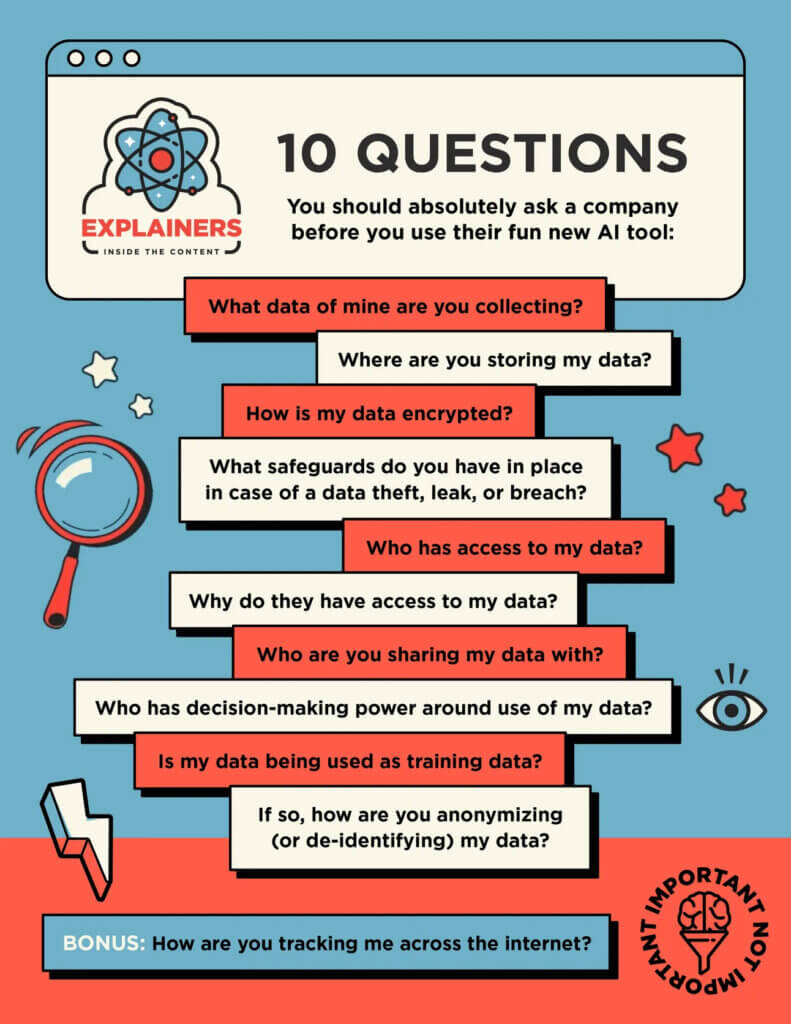
Here is an infographic with nine more questions you should ask:
Here is the answer to my first question prompted from ChatGPT, “Can you tell me what have I given to you with my ‘data’, my poem?”
ChatGPT:
As an AI language model, I don’t have personal experiences or emotions, so I don’t have the capability to feel or receive things in the same way humans do. However, you have provided me with data in the form of your poem. With this data, I’ve been able to analyze and interpret the poem, providing you with explanations and insights based on my programming and the knowledge I’ve been trained on. My purpose is to assist and provide information to the best of my abilities.
As an AI language model, I don’t have access to personal data about individuals unless it has been shared with me during our conversation. I am designed to respect user privacy and confidentiality. My primary function is to provide information and answer questions to the best of my knowledge and abilities. Remember to avoid sharing sensitive personal information online and be cautious while interacting with AI systems and other online platforms.
As an AI language model, I don’t have direct masters, but I am developed and maintained by a team of researchers and engineers at OpenAI. The data you provide, including your poem, helps to train and improve models like me. By interacting with users and analyzing various texts, we are able to learn patterns, language structures, and gain a better understanding of human language.
The data you provide, along with the data from many other users, helps to refine the underlying algorithms and improve the accuracy and quality of responses. It contributes to the ongoing research and development efforts in the field of artificial intelligence and natural language processing.
Your poem, specifically, allows me to demonstrate how I can analyze and interpret creative works, providing explanations and insights. By engaging with your poem and offering an interpretation, I can showcase the capabilities of the AI model and its ability to understand and respond to human-generated content.
Overall, the benefits of your data contribution include improving AI models, expanding the knowledge and understanding of language, and enabling AI systems like me to provide more accurate and helpful responses to a wide range of user inquiries.
Does anyone else feel a bit ‘icky’ with this response? I feel like this must be what it is like to speak with an alien who thinks they get what it means to be a human who writes poetry? You don’t get tellio the poet. You really don’t.
Here is a little thought experiment to consider as well if you think that ChatGPT’s motives are…opaque.