
I was listening to one of those eye-widening YouTube videos from Oxford University’s Martin School and thinking to myself, “I don’t understand everything I am hearing the speaker Dr. Penny Mealy say, but I do get that this is wildly important and worth watching again.”
The video is about “how novel analytical tools are providing new insights into the use of knowledge in society, and highlight implications for economic development, inequality and the transition to the green economy.” Short version: how can we visualize complexity and use those images to improve our lives? Take a look. I guarantee you will find something that will shake you up.
The whole lecture really delivers the goods. Here are some of my takeaways and questions.
- Small changes in educational attainment level make for large differencecs in economic development down the road. And I have to ask, “For whom?” The answer is, of course, for those most of in need of improvement. Not the already filthy rich.
- We might just be getting stupider in rural areas as populations move with their feet, a brain drain. Given much of the rural South’s propensity for draconian limitations to women’s reproductive rights, I suspect this ‘stupefaction’ might be gaining at an exponential rate. (Aside: neither of my adult daughters lives in Kentucky where her parents live. Smart girls.)
- Quantifying knowledge–isn’t this what ed folks call ‘assessment’? I suspect not. Most ed assessment is…bullshit.
- New names and voices for me: Susan Hidalgo and Ricardo Haussman: The Atlas of Economic Complexity
- Most knowledge work analysis is an undifferentiated blob of aggregated data that tells us almost nothing about the different kinds of knowledge and knowing. Maybe this changes that overgeneralization?
- “Know-how”–what a grand word!
- Question: how do we keep from getting lost in ‘higher dimensional knowledge space’? Borrow from the Dewey Decimal Classification System and categorize in economic complexity terms.
And so much more…these takeaways are only up to the 20:00 minute mark.
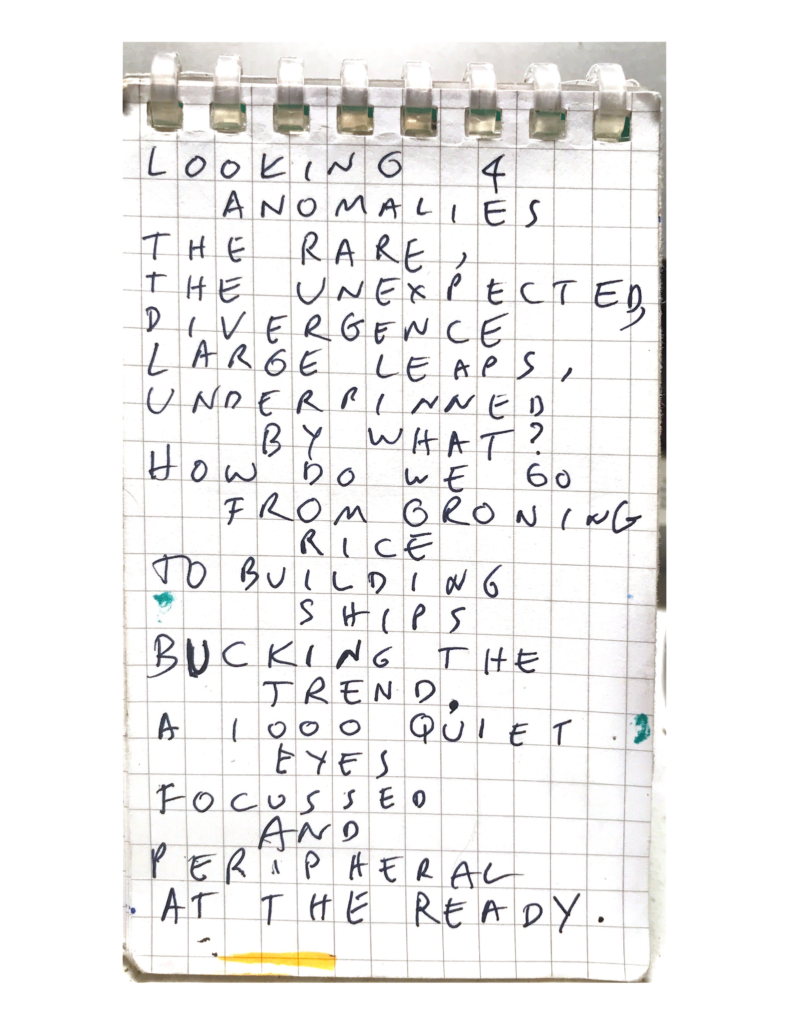
I was also struck by how much poetry leaks out of the talk. So I gathered up some from the 40:20-42:24 mark. I improvised a poem from it by using my favorite daybook, the Lihit Lab AquaDot with graph paper, to create a draft of a poem. I scanned it using the super handy iOS app, Notes, and then uploaded it here.
Just an aside: if you enlarge the photo you can see the rough, analog edges in the paper along the spirals at the top, the bleedthrough from the previous pages, my own quick, all-caps font, and the superior paper quality and contrast of the AquaDrop notebook. These haptic qualities make all the difference for me in my writing experiences.
Here’s a revision in Wikimedia’s Etherpad.
Here is another playful view of the poem that arose from the YouTube video:
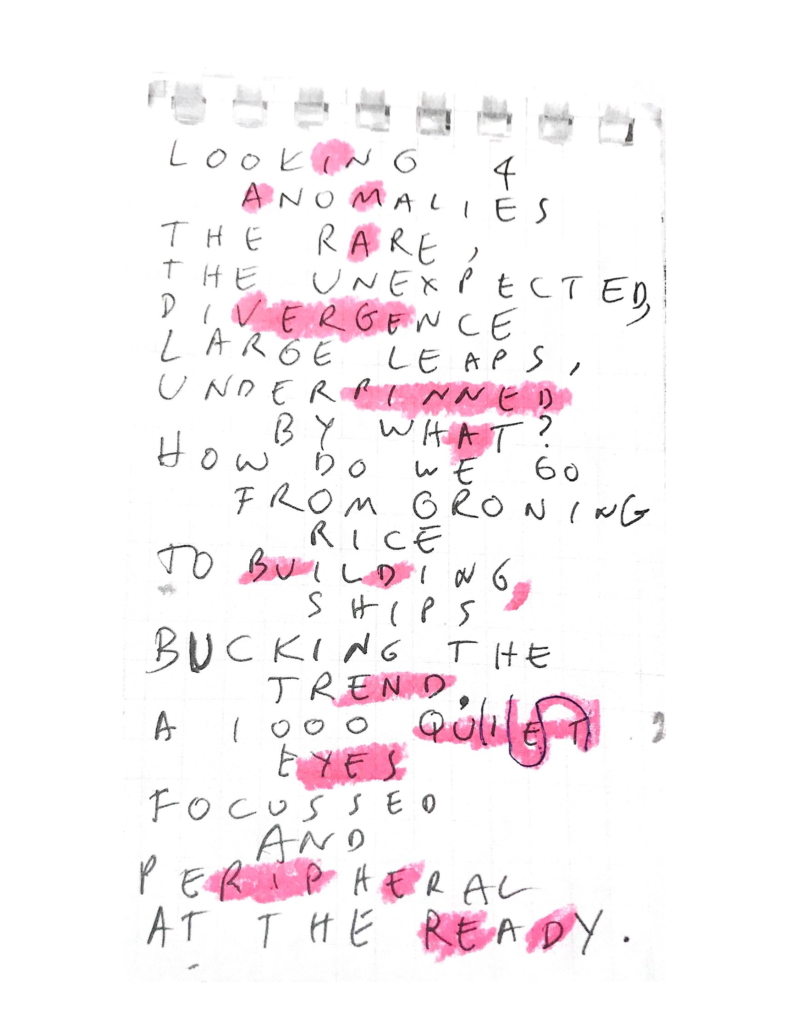
I am a verge,
pinned.
A bud end, quite.
Yes.
Ripe.
Ready.
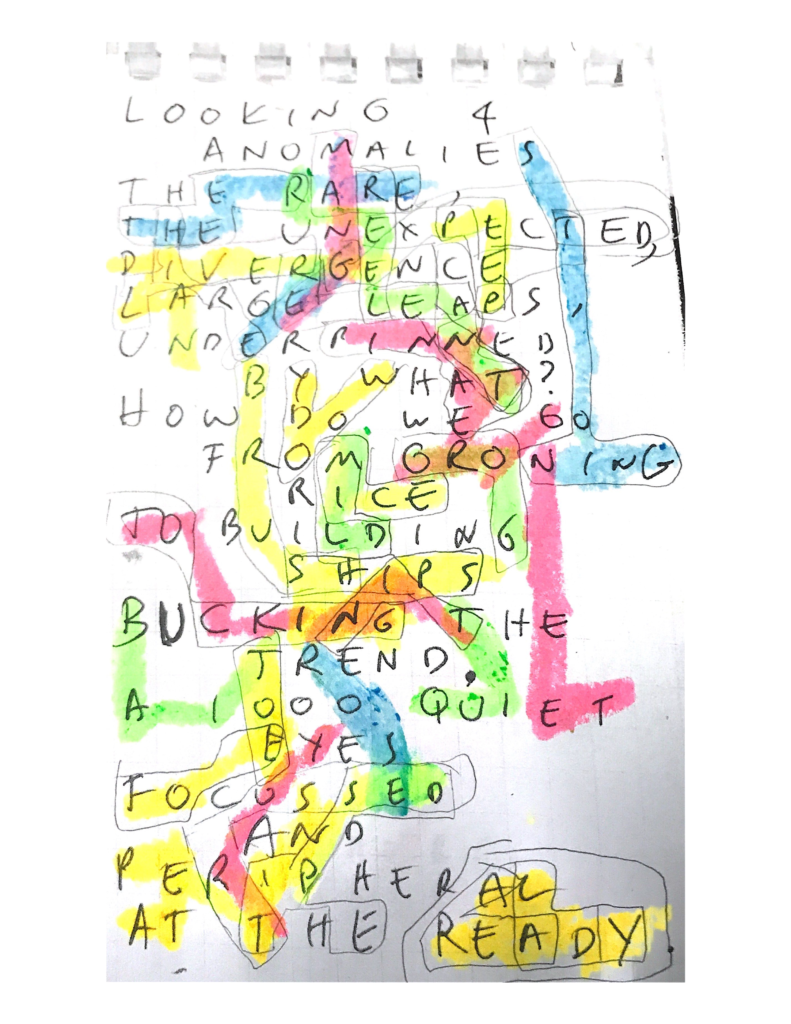
And a word find here, accidentally created when I wrote the poem.
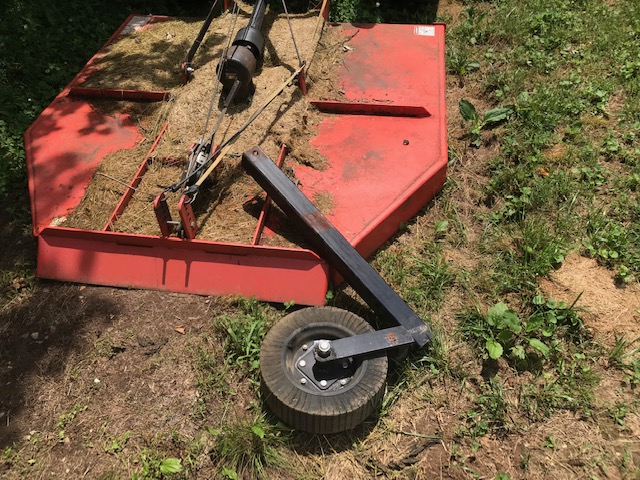
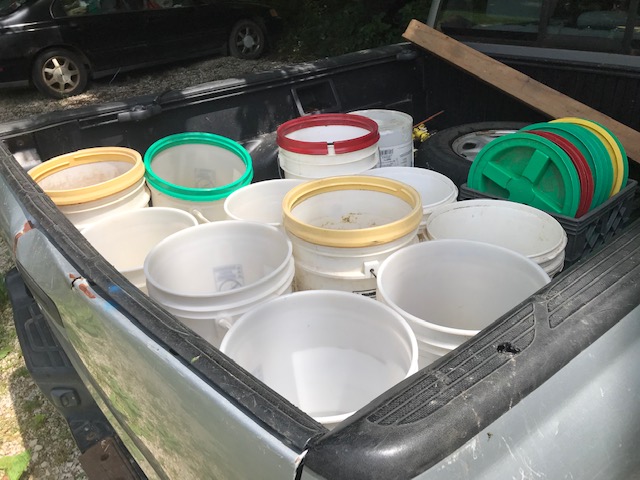
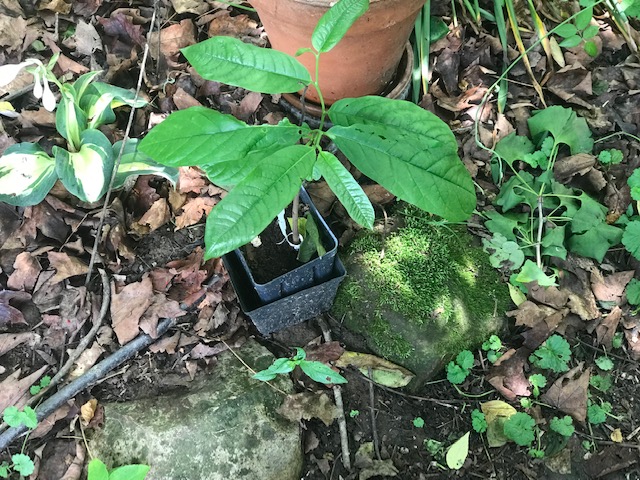
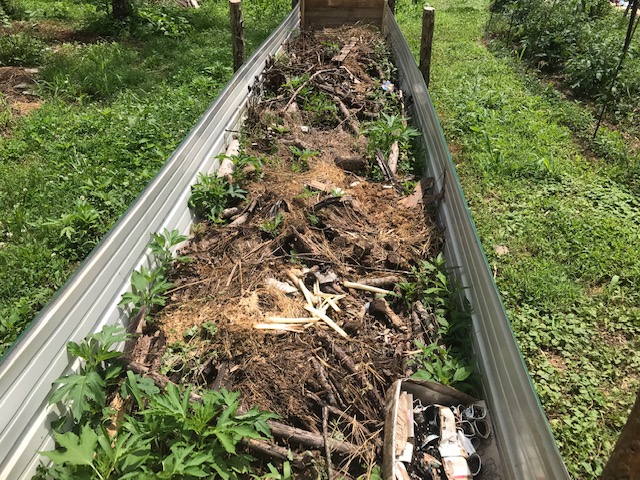
And, of course, the work of the garden and farm, the outside knowledge space, goes undone, waiting for me to finish this:
and this
and this
and last
Permalink //
If you put the video on Vialogues I will view it with you.
Permalink //
Here ya go, Dan. https://vialogues.com/vialogues/play/51090/
Permalink //
I could spend a few hours here with what you wrote and shared and whatnot. Such an interesting journey …
Kevin
Permalink //
An aside: I saw your ethernet pad over there (at YAP) and wrote with you, only to later come back to here, where it all started, and I find it intriguing that a poem seeded in different places — a poem, with invite — might take on different masks, different contexts, different contours …. I’m no longer sure what I wrote makes sense in the context of “here” as opposed to the context of “there” but I won’t remove a thing, and let the words sort of linger.
Kevin
PS — ZOOOOOMMMMING in to see the edges of your analog paper trails …
Permalink //
Thanks for setting up the video on Vialogues. I will Visit you there over the coming week.