Desire Paths, Legibility, and Minimally Viable Complex Systems (or how not to apply for a job)
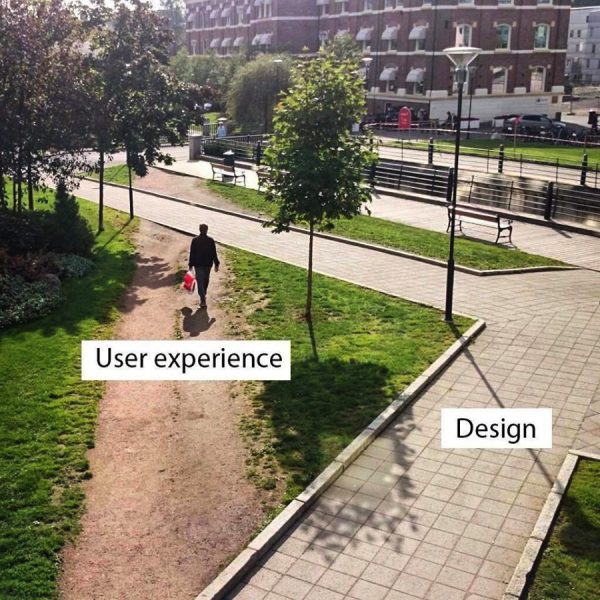
This image is the best description of what a “desire path” means. If you think of it like I do, you might see the established path in the picture as a design requirement. For example, as a teacher I am told by my university that a research paper is necessary when I teach my writing courses. For many of my first-term students this means repeating a pain-filled and fearful exercise from the past, something they learned to hate in high school, something to throw away as soon as possible.
The hypotenuse in that picture is what I try to encourage. I offer them the chance to come up with their own research question and their own format for answering it. Most students don’t believe me when I tell them that this is a research project. I tell them that project means it could be a podcast, a series of online vids turned into a YouTube playlist, a Prezi presentation with videos included, or…well, whatever they feel will answer their question. I have had students create business plans, zines, handbooks and, of course, papers. They make this path as they walk it.
I am going to be interviewed for a job today (Wednesday, December 2) where this issue might arise. Maybe I can show them this picture by way of explanation.
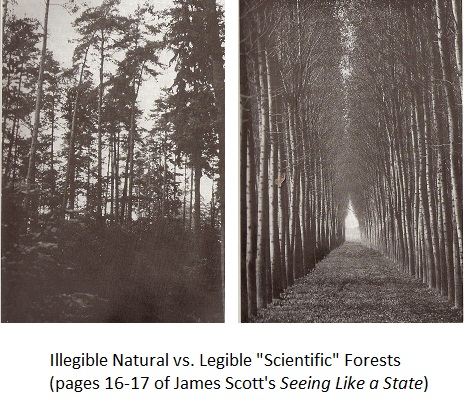
Here is another picture that also defines who I am as a teacher and even as a teacher of teachers.
Scott’s idea is that this picture describes a “failure pattern”. He calls this pattern “legibility’. Large institutions and even governments are susceptible to this failure as are individuals. Venkatesh Rao lays out what he sees as Scott’s ‘recipe’ for failure,
Look at a complex and confusing reality, such as the social dynamics of an old city or a forest
Fail to understand all the subtleties of how the complex reality works
Attribute that failure to the irrationality of what you are looking at, rather than your own limitations
Come up with an idealized blank-slate vision of what that reality ought to look like
Argue that the relative simplicity and platonic orderliness of the vision represents rationality
Use authoritarian power to impose that vision, by demolishing the old reality if necessary
Watch your rational Utopia fail horribly
I have spent 25 years learning how to allow minimally viable, complex learning ecosystems to evolve. It is messy and necessarily so if we are to trust Scott’s idea of legibility. The German government could not easily tax the messy forest on the left. How could you figure out acreage, yield and market value? Well, not easily or fairly. The state cannot have that so scientific forestry, aka monocropping, is invented to create a legible system, an “idealized blank-slate” of reality. And this isn’t a metaphor, this is a very concrete pattern.
To quote Mencken, “For every complex problem there is an answer that is clear, simple, and wrong.” Amen. I am pretty sure knowing this has made my teaching more interesting and better for my students, but I don’t think it makes me more hireable or made my teaching life easier.
Creating the conditions for multiple desire paths is like creating a hedgerow. It is wasteful, messy and counter-productive, but it also more sustainable in the long run because it supports a much wider range of all living things, from bacteria and fungi to shrubs and trees including all the creatures great and small that live there. Nobody thanks me or will ever thank me for creating these margins, especially those who are viewing them from above or from the seat of a bulldozer. Yes, because hiring is also an exercise in legibility, simplifying my 25 years of teaching into a CV or a cover letter or a statement of philosophy or a clever interview question that gets to the heart of anything. The rational utopia of making a perfect hire does not exist and any attempt to make it is doomed to fail horribly. Of course, I could be wrong, but…
I agree w(hole)heartedly. As I created an ePortfolio this week for my next internal job ‘expression of interest’ I longed to just put blank boxes and invite questions about the white space between these boxes. Not no, I dutifully filled in the boxes and wrote stuff about my history that in no way indicates what I might do in the future. I sighed, hit publish and took and long lunch break.
It’s all about feedback and little about feedforward. I wonder how much of that thinking comes from the spatial metaphor that the future lay ahead and the past behind. What if the future lay behind, unseeable, while the past lay ahead, legible and apparently rational.
I have been alive almost 66 years.
I have been married 42 years.
Our oldest child will be 40 next year.
I have been teaching for 25 years.
I have been sheep farming for 25 years.
I have lived in the same place for 31 years.
Nowhere in that illegible catastrophe
Is there an interview question.
As I read your post and looked at your zest video I thought of my own feelings about reaching out to philanthropists and political leaders to try to gain support for my work, or to get them to add my ideas and thinking to their own efforts. It’s frustrating since I’ve no “elevator speech” that instantly conveys what I’ve been trying to do for the past 25 years or why it might benefit them to dig deeper and understand how my archives might benefit them and those they seek to help.
I wrote hundreds of letters and grant proposals between 1990 and 2011 to try to fit who I am into a one page letter of introduction, or a 3-4 page proposal with questions they want answered, using 1000 or 2000 characters. Each time is a labor of love that most times was rewarded with “thanks, but no thanks”.
Thus, since 2011 I’ve let my archives, blog articles, tweets, and endorsements by others be my resume, aiming to connect with the few who already have made an effort to learn who I am and what I do. A few people such as yourself have taken the time to get to know me, and have even sent contributions, so the process works, even if slowly.
That’s creating a new ‘desire path’. So far few others are using it, but I keep trying.
I hadn’t had time to follow your breadcrumbs back here – I only saw your poem. I guess that might have been enough. But here I am, a day late, and hoping all went well.
Kevin

Permalink //
I agree w(hole)heartedly. As I created an ePortfolio this week for my next internal job ‘expression of interest’ I longed to just put blank boxes and invite questions about the white space between these boxes. Not no, I dutifully filled in the boxes and wrote stuff about my history that in no way indicates what I might do in the future. I sighed, hit publish and took and long lunch break.
Permalink //
It’s all about feedback and little about feedforward. I wonder how much of that thinking comes from the spatial metaphor that the future lay ahead and the past behind. What if the future lay behind, unseeable, while the past lay ahead, legible and apparently rational.
Permalink //
Here’s a Zest link with my own comments to this post in my own voice: https://app.hellozest.io/share/c8b7b5d5-1872-40c0-aeaf-c44acc973559
Permalink //
I have been alive almost 66 years.
I have been married 42 years.
Our oldest child will be 40 next year.
I have been teaching for 25 years.
I have been sheep farming for 25 years.
I have lived in the same place for 31 years.
Nowhere in that illegible catastrophe
Is there an interview question.
Permalink //
I hope the job interview went well.
As I read your post and looked at your zest video I thought of my own feelings about reaching out to philanthropists and political leaders to try to gain support for my work, or to get them to add my ideas and thinking to their own efforts. It’s frustrating since I’ve no “elevator speech” that instantly conveys what I’ve been trying to do for the past 25 years or why it might benefit them to dig deeper and understand how my archives might benefit them and those they seek to help.
I wrote hundreds of letters and grant proposals between 1990 and 2011 to try to fit who I am into a one page letter of introduction, or a 3-4 page proposal with questions they want answered, using 1000 or 2000 characters. Each time is a labor of love that most times was rewarded with “thanks, but no thanks”.
Thus, since 2011 I’ve let my archives, blog articles, tweets, and endorsements by others be my resume, aiming to connect with the few who already have made an effort to learn who I am and what I do. A few people such as yourself have taken the time to get to know me, and have even sent contributions, so the process works, even if slowly.
That’s creating a new ‘desire path’. So far few others are using it, but I keep trying.
I suspect you’ll do the same.
Permalink //
I hadn’t had time to follow your breadcrumbs back here – I only saw your poem. I guess that might have been enough. But here I am, a day late, and hoping all went well.
Kevin