Our Spent and Ashen Selves

I have felt a creative vacuum of late.  I haven’t been able to bring my way of looking at the world into the world.  It helps when folks attend to your observations. It makes me feel alight when I can share.  There are probably reasons for these dolorous times, but I seem to have broken ranks with the forces of passivity with this poem.


My Ashen Muse

Every day
I look up
and displayed
on a metal shelf
above my desk?
My brother’s dust.
I move his ashes around.
One day he is at hand
and another
barely in earshot..
One day he is
out of grasp
and another
he is eye level.
When I touch the urn
that carries him
I feel
he is a semaphore
or an emoticon
or a metaphor
or a figure
dancing,
an eye floater,
a persistent image,
a phosphor blip
on high speed film.
Sometimes
he stays in one place
and others
(I do not know how)
he has moved.
Sometimes he is
a scrying bowl
and others
he holds my tears
intermingled
within his ash aquarium.
Most days
he is not a cliche,
not a reminder,
not an instrument
of something,
not a tool.
He is what remains,
a filter-through
of memory
and time
passing
and held together
with nothing but cardboard
and a twine hasp.
Not a final rest
but a respite
while I consider
a more apt
spot:
perhaps the muddy flooded creek
or with the horsetail
and the peepers
in the wetlands
or 150 feet up
in the heron aerie
or on the wind
of a spring tornado
or with the efts and salamanders
wriggling and stretching
in the moldering leaves and
feeding all the tendrils and hyphae
in reach.
However his entropy
shakes out
the electric circuit of the earth
will fold him into
itself
and me too
and you as well.
Now and forever forward,
our futurity assured.
Amen.

Feldgangs 4 All: Walks in the Pastures of Attention

I borrowed the term ‘feldgang’ from Otto Scharmer. What he refers to on a literal level is simply a Sunday walk in the family farm pastures and fields with no intent other than to woolgather (That is an etymological gem we won’t explore here for the moment.) Figuratively, it can mean any “field”. For example, your field can be a website. That is how I am using that metaphorically in this post.

The field in this case is being made real by a tool, Webrecorder. With that tool you can record your footsteps, blazing a trail of sorts, in your own way. Folks can follow your trail even looking at the same videos and sound recordings and hyperlinks that you did. What use is this?

It all started with a plea for attention from my compadre, Kevin Hodgson.

This is a call to attend. Attend what? At a bare minimum Kevin asks us to check this out. You might be interested. In an attention ecology like Twitter, this is big ask. It means to drop what you are doing and do this. What I want to know is this? What do different folks consider reciprocation. In other words what is my duty here when my friend asks folks in a particular context to explore.

What I did is below? I think this combination of Webrecorder + Screencasting allows for a more careful reciprocal exercise. This is what it means to walk in the pastures of attention. At least, this is what it means to me. I would love to do something similar for a smaller pasture (a blog post with links) or something larger (Tweetdeck) that has different purposes to the feldgang.

For now, this is what I did in response to an ‘ask’ for attention, my feldgang.

So, I have set up the metes and bounds of the feldgang above. Below, I screencast my walk in the fields, some pasture, some hedgerow, some woods. Think of it as a director’s cut to the webrecording above.

And the coolest think of all is that you can upload the screencast to Vialogues for further analysis.  A group of teachers could get together, choose a common text, create a webrecording, do a screencast, and the analyze the video as a quick and dirty action research project.  I advocate for these kinds of collaboration because they lead to an appreciation of how we direct each other to attend in different ways for different purposes.  Perhaps that could be a filter to getting us all to think more deeply about what we ask of others online.  I think this is classic solidarity building and understanding of knowledge as a commons.


Counter-Love, Original Response: Tracing My Daughter’s Tracings

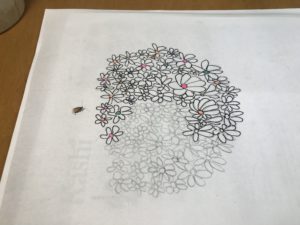
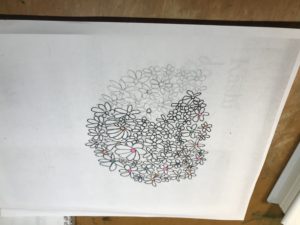
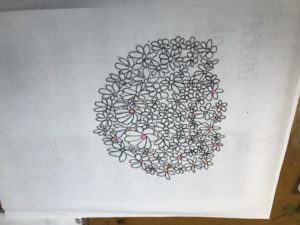
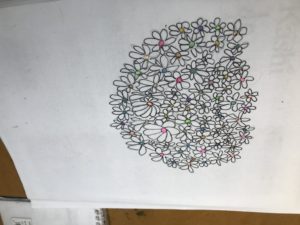
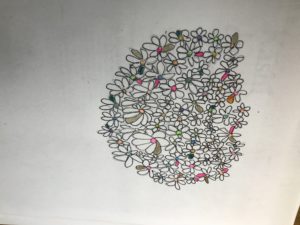
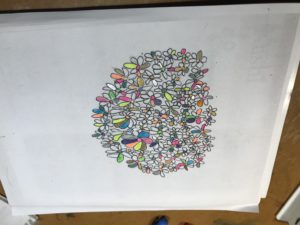
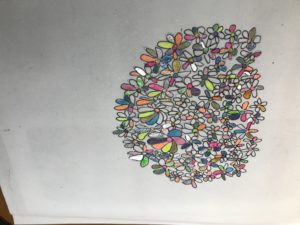
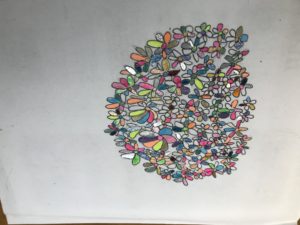
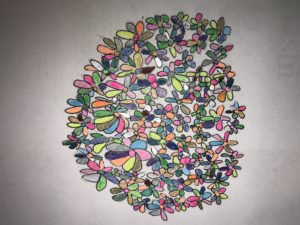
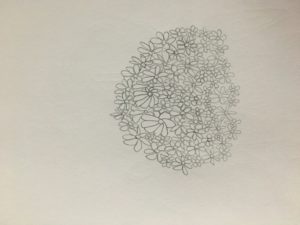
My daughter drew a repetitive series of flowers.  I wanted to be a part of what she created so I decided to outline with a black marker then color.  I had no conscious plan.  Below is the course of events as I photographed various stages of development.  I think this is what Robert Frost called “counter-love, original response”

Here is the poem Frost wrote where he describes this concept.

The Most of It

He thought he kept the universe alone;
For all the voice in answer he could wake
Was but the mocking echo of his own
From some tree-hidden cliff across the lake.
Some morning from the boulder-broken beach
He would cry out on life, that what it wants
Is not its own love back in copy speech,
But counter-love, original response.
And nothing ever came of what he cried
Unless it was the embodiment that crashed
In the cliff’s talus on the other side,
And then in the far distant water splashed,
But after a time allowed for it to swim,
Instead of proving human when it neared
And someone else additional to him,
As a great buck it powerfully appeared,
Pushing the crumpled water up ahead,
And landed pouring like a waterfall,
And stumbled through the rocks with horny tread,
And forced the underbrush–and that was all.

I am not so sure about the originality of being an adult colorer, but to trace my daughter’s hand, to contemplate her, to honor her–that is both counter-love and original response.  I love you, Phoebe.