

I freely admit that this is a mess of post. Some might view it as wail for attention. Feel free to ignore the whining if you wish. Feel free to wander away and pick your nose. Feel free to check your various personal learning networks, but …wander back please.
I wanted to write a post/article about outsiderism, the idea that the best ideas, the best reform, the best chance for legitimate change comes from outside the discipline or, failing that, from those on the margins within a discipline.
Question: are the facilitators and leaders and participants here outsiders or are they ‘rearrangers’? Are we cozy web makers or are we punks? Fuse lit.
My idea of the consummate outsider is architect, Christopher Alexander. Alexander has long been a gadfly to the architecture community. Since the beginning of his career and throughout the creation of his multi-volume works (starting with A Pattern Language) his emphasis has been upon local, humane, sustainable, and intelligent design. In his latest book he really takes on the role of outsider, pariah even, when he blames those in his own profession for the death march that is modern architecture and design.
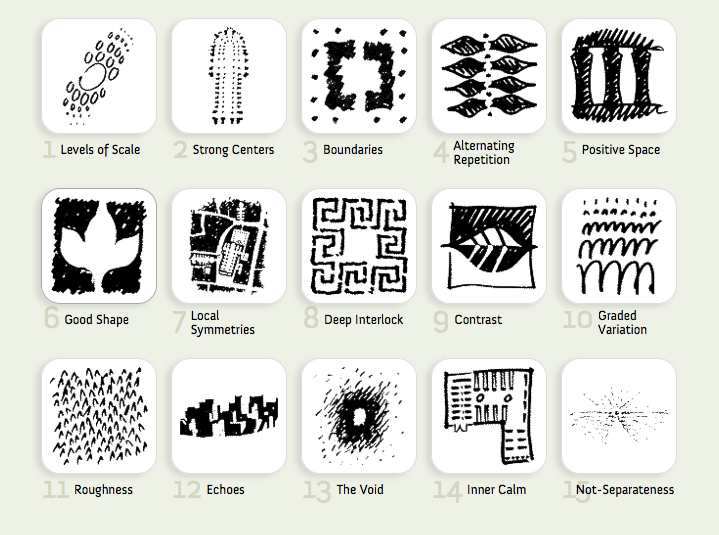
I feel the same issues with the materials of modern university life, online and face-to-face. They (the insiders) are killing the good that universities do for learners. Perhaps Jim Groom’s abandonment of edupunk and Alan Levine’s disdain for the word “lurker” are part of a growing outsider movement. Perhaps Howard Rhinegold has always been on the outside looking in. Yet I have to ask: are they (including Mike Wesch, Cathy Davidson, and Randy Bass) enough outside to pull the center to the margin? I really don’t know.
Alexander’s critique is that humans design systems, but they are not currently at the center of the system. In his latest book, The Battle for the Life and Beauty of the Earth, Alexander divides all of architecture into two, prosaic camps: System A and System B. System B is all about efficiency and hierarchy. It is about power and control and productivity. All of which is well and good within its proper context. I want the centralized control systems built into the flying and landing and taking off of airplanes. I don’t want it nearly so much in the ‘ergonomic’ fascism of bathroom design or of learning management systems.
(Aside: anyone who has read Iain McGilchrist’s The Master and His Emissary will note some spooky similarities here.)
System A is all about integrity and health and the folk not as nodes in a machine, but as a growing, adapting, distributed and living whole. It is the difference between a neighborhood and a housing development.
Each of these systems is, in Alexander’s mind, generative. System A is open, sustainable, regenerative, and feels good. System B is oppressive, closed, degenerative, and exhausting. Take your pick. And lest you counter that this is a false dichotomy, you need only look in architecture and higher education for System A generated spaces. There are not that many. Alexander notes that the two systems entail a zero sum game: for one to thrive the other needs to diminish much like predators trying to occupy the same niche in the food chain.
I have a lot of questions about whether any of the web-based tools we are using actually fit the mold of System A. I don’t often feel those spaces as convivial and natural. Behind the artifice of interface lay the reality of code. Is that structure humane? Is it open, sustainable, and regenerative? Does it feel good? Does the whole idea behind code generate System A or System B? I really don’t know.
What I do know is that I get the very distinct feeling that certain systems I use are not convivial. Google+, Facebook, WordPress, Twitter while full of humans, feel closed, feel like templates to be filled in not spaces to be lived in. Hence, the need for outsiders more than ever to raise the question especially in this week of connected courses where we are talking about the why of why.
I am an outsider as many of you are. I came to teaching late after fifteen years of farming and running a couple of businesses (taxes and chimney sweeping). I came to teaching through substitute teaching. WTF. I started teaching at age 39 in a rural setting of intense poverty and dying culture. The culture that was dying was agri-culture. My wife and I unschooled our kids in a time when that was the perceived province of the crank and the zealot. Whatever. I am an iconoclast in a job that values lockstep. I loved the vicious, soul crushing little bastards who I was charged with graduating. Little more was asked of me. I am an outsider who thought that perhaps I could lay a set of parallel sidetracks next to the well-worn ones of System B, an underground railway designed to lift up, carry forward, and sustain those fleeing the plight of System B.
I am still an outsider running an underground railway and I am needing folks to guide me: is this connectedcourses System A or a well-disguised System B. I know how badly that system can abrade, chew up,and spit out its conductors. This paranoia has some pretty deep roots that don’t actually entail black helicopters and the Bilderberg.
So…will the tools we are using and advocating generate System A or System B spaces? Is it even possible to have a System A that arises from our own or other’s codings? How will we know that we have not deluded ourselves, that we are so invested in the time and energy and pride of creation that we fall into the sinkhole of bias and blindspot? I am older than most of you. I don’t have time for this if it’s just another System B in disguise. I have been down that road and it wasn’t of my own making and it doesn’t have a fork in it suitable for a commencement address. (BTW, Robert Frost was not a sweet grandfatherly old gent in that poem. Not very really.)

Alexander’s story in his latest book is one the extends from 80’s to the present day. He continues to fight against the architectural forces that value the modular over the adaptive, the global over the local. His project, the Eishin School, continues to be under fire by the powers-that-be in Japan. He continues to fight back. He is still the consummate outside. He believes in design from the folk up. I will use that yardstick to measure everything I will be trying from this course and in my courses. Is everything I do designed from the folk up? Is everything you do designed from the folk up? Is it humane and regenerative and sustaining, and alive? Or does it just serve the status quo ante bellum?
Thanks for letting me take this feldgang. A feldgang is what farmers do all the time. Fieldwalks. On my farm I see the hope of a rainy August. I see all kinds of forbs for my sheep to eat. Deep rooted docks and Queen Anne’s lace, plaintain weed and hop clover and red clover and white clover. Fescue and chicory. It is a meadow fit for a ruminant. Usually it is pith dry. Sometimes the fallen and broken branches get trampled further by our sheep and as they walk through they sound like marimbas being janked around by a hyperactive eight year old. Yes, this August is rare. I hope that #ccourses is a rainy August. Many feldgangs await. I have been accused of being hyperbolic and of wildly inflating conditions on the ground. I really do call them like I see them. I just need help seeing what I observe. Help me see.

Permalink //
Am I enough outside? I think both Stanford and I would answer in the affirmative. Mostly, I fly under the radar. I’m not a tenure track faculty, I’m a “visiting lecturer” (fancy term for adjunct). I don’t publish in academic journals, nor would most of them accept me. I don’t have an advanced degree. However, I welcome every critical stance. And thanks for introducing me to “feldgangs.”
Permalink //
I’m wanting to let your post sink in some more at the same time send an “I heard you” response. If you seek affirmation, Terry, let me thank you for your outsider views. Almost every interaction your ideas make me rethink on your questions.
I may not go far as to say the best ideas come from the outside, and their are certainly a lot of bad ideas outside, but fully support the power of turning one’s attentions beyond the usual circles, somewhat of a lesson I took away from Steven Johnson’s “Where Good Ideas Come From” and an interesting concept I wandered across a few years ago on “Structured Serendipity”
http://edge.org/q2011/q11_2.html#zweig
Being not inside a system I am not quite sure where inside ends and outside begins, and at some level, the internet seems to serve as one of the best possible ways to mingle with outer ideas. Of course at the same time one can stay inside their friends circle online. The system does not guarantee the serendipity, one has to make choices that create its potential.
I think you described this, but for all things System A we need system B things to enable it. The roads to get to your farm, the tools you might need for working the land, the parts of a tractor, maybe even our very bodies themselves are system B things we need.
So say if one its own Connected Courses is A or B. It might change for the individual. It might evolve/devolve. Do you know in the midst of it? It sure feels Aish to me.
Its interesting for you that WordPress feels not convivial and constrained. It can be for many people because they perceive its limits. To me, who spends a lot of time tinkering, modifying, and bending WordPress, its the opposite- its a structure, but having experience and ability to change it, I find it quite open ended in potential. But then again, I love coding PHP and tweaking CSS. The limits of a system again vary with our abilities, perceptions, experiences.
Like Howard, I appreciate the word “feldgang”– I never knew my daily ritual had a name! I live on but 1/3 of an acre of land, but the best part of my day is just walking around, noticing what has changed- new flowers, mushrooms, things that need trimming, and what I enjoy as a daily photo habit since 2008– i bet more than 75% of my photos have come from this 1/3 an acre. The daily routing is to find something new, be it just lighting, shadow, patterns, shapes.
Permalink //
I appreciate your affirmation and validation, but more than that I thank you for your tireless passion in helping others stretch their own online spaces into something that is more humane.
I use a Steven Johnson’s essay in teaching my students how to write summaries: http://goo.gl/hvOHGJ ,”The Genius of the Tinkerer” I love it for introducing me to Stuart Kaufmann’s idea of the ‘adjacent possible’ and now I thank you for introducing me to ‘structured serendipity’.
The system ideally is serendipity personified, in actuality it can be an echo chamber. Take Twitter, please. (http://soundbible.com/779-Joke-Sting.html “Rimshot”) I love to watch the river of tweets flow by with same ‘grouper eating a shark’ video surfacing time and again.
And just because you are outside the system or the structure or the norm, it doesn’t mean your particular brand of crazy is helpful. Or, if I want to aggressively humble, mine. And right again–sometimes you gotta rattle the cage to get the parrot to talk or the tiger to even turn its big whiskered self toward you.
Yes, we need system B, but that’s Iain McGilchrist’s contribution to this argument–the emissary has become the Master and won’t share the wealth or the power or the cool toys. In fact System B spends much of its considerable strengthsjust reinforcing institutional imperatives. System B does not play well with others. He is the worst kind of only child.
WordPress to someone like me who only understands the dashboard as a dashboard, I can’t get messy with it, I can’t become convivial with it, I can’t dance with it unless I invest in it. And that is always the ante up, isn’t it. I am sure that a Blackboard sysadmin would say the same, but I would never take that bet. Thank God you do get messy and that I can at least get the sense that there is a vibrant, accessible engine under the hood. Now that is an outsider’s gift for sure! I just wish I could grow it like I do a meadow or a crop of winter turnips for my sheep.
I share the simple act of observing and acknowledging that constitute my feldgang. The top and bottom photos above are from my garden. The one on top is a labyrinth of hummingbird vines and tomatoes living symbiotically. I am hoping that the vine will give the tomatoes a bit of frost protection. The bottom one is a square of pasture next to the garden. I stand in awe every time I look at it. It is exactly analogous to a Hubble photograph of distant galaxies and I understand it just about as well.
Thanks for the grand comment. I have a couple of interns who I work with on blogging and, with your permission, I will use your comment as an exemplar.
And if you want some fun on a Friday watch this short video: http://youtu.be/Cbk980jV7Ao” “Validation”
Permalink //
I think you are enough outside. I have always thought so, but what I think is by the by. It is your ideas and crap-detection that are what’s important to the infinite game we are all playing together, this living conversation. I want to speak with and learn with folks who can drag my pov at least a bubble off level and who make me reconsider. I think that I know that in principle that almost everything I know is wrong so I need the recalibration from outside myself. Too many blindspots to do it myself. Hence, the need for every critical stance. As a student of litcrit I may not put any stock whatsoever in Freudian character analysis, but I do have to admit it gets me turned about and considering another vista. Thanks for introducing me to virtual reality and smart mobs and the Whole Earth catalog and…you got the bonafides, man, and you certainly don’t need some sheep farmer in Kentucky to tell you that you have been dragging us kicking and screaming outside the cave for a while now. I know I am grateful for that courage. I have depended upon it and I thank you for it.
Permalink //
Wow! That feel nice. Whole Earth is where I learned to question my assumptions. If an issue didn’t piss off some readers, I knew something was wrong.
Permalink //
Thanks for your thoughtful post. I read it and immediately thought of an article by Elizabeth Moje (2009), where she asks if the research about new literacies is about literacies that are truly new, or if people are simply the same old literacies situated in new media or using new tools.
In the new world of learning that is struggling to be born through this MOOC and others, at least in higher ed, it would seem that System A may need System B to launch itself, a weird kind of symbiosis, in a way. Yet, even via a self-hosted platform, the software inevitably shapes what happens through it and with it. Other people have written the code that makes any of it happen. We just learn to wield the tools. And, as you suggest, learning it takes an significant investment in time.
I undertook a self-hosted WP blog because I wanted see if moving away from someone else’s platform would leave me bounding though the virtual streets shouting, “Free at last!” So far, not so much. However, what I immediately do see is the power I have to control what goes up on the site, how it gets shaped, how long it stays. That’s good. As an example, the Ning sites I used in my classes are long gone and there was stuff there I think students would have liked to access.
But note that I say “my” classes. All the why questions being considered are important, but I think there is another one, one that gets to a layer beneath all the whys of this week. That one is, “Who gets to decide?” Then comes another: “Why?”
Your decision to unschool with your kids speaks to this. No matter happens with this MOOC, any MOOC, it still lives within cultures and structures and expectations that are informed by the long traditions of academia. Thinking about it that way, who’s an insider? Who’s an outsider?
What I appreciate about this MOOC is how clearly it’s organized. I appreciate the consistency of the theme of connectedness. I appreciate the clear communication about how a one of participant’s opportunities is it to use the available tools to try to connect with others.
I also know there are lots of newbies who are signed on to #ccourses. Talking about trust is interesting– a System A concept. I wonder if some quasi-B talk would also be helpful: how do you use the tools to reach out to others in order to connect? Do the experienced folks have an obligation to reach out and initiate the noobs, even a little? That’s another insider-outsider thing for me to consider, and a question I try to think about in designing any course.
The word “community” is used a lot in online spaces. We probably need to do a better job of interrogating exactly what that means. What constitutes a community? I don’t know that talking with others via Twitter or any other mechanism is enough to make me feel like a member of a community. Maybe that’s why it doesn’t surprise me that there’s research out there that indicates the most effective online courses have periodic F2F meetings. I watch the Twitter stream go by and wish I were the kind of person who could jump in and feel like I’m part of the gang. I feel shy, most of the time, and on the outskirts. Sometimes I feel that one of my jobs as a participant in online worlds is to drink the Kool-Aid. I’m not good at Kool-Aid.
I want to formulate more thoughts about All This: Connectedness (is that just a form of System B?); MOOCs; how the affordances of Web can truly disrupt this thing called education. I want to believe it can.
And I’m sorry for how long I’ve gone on– this is probably more of a blog post that a comment! In fact, I think I’ll stick it on my blog.
——–
Moje, E. B. (2009). Standpoints: A Call for New Research on New and Multi-Literacies. Research in the Teaching of English., 43(4), 348–362.
Permalink //
Marvelous comment/post. One of the theories of commenting I subscribe to is the ‘compliment and complement’ school. This is a classic example. Wonderful. Just a few quick notes:
1. Thanks for the article by Elizabeth Moje: http://www.jstor.org/stable/27784339 Straight into my Pocket account.
2. “software inevitably shapes what happens through it and with it.” Straight from the McCluhan and much agreed. Systems are like functions in calculus–input/output
3. “Free at last!” So far, not so much. –I laughed out loud at this. While I love self-hosting just because it’s mine, I also know that since I can’t open it (can’t code WordPress) then I don’t own it.
4. Ning sites: Jeez, don’t get me started. Ning’s treachery was the final indignity that led me to self-hosting and the depths of cPanel.
5. “Who’s an insider? Who’s an outsider?” When you have heard this phrase or its equivalent, “You haint from around hyah, are yuh.” You pretty much know. It may well be a continuum but one that defines pretty clearly each term. I can get by with the idea that the outsiders are really just hyper-marginalized insiders. But the big difference is that radically marginalized are no longer interested in making nice with the insiders. They have been there.
6. “quasi-B talk”–my argument is that System B can’t play with system A very well. In fact it can’t abide serving System A. So…There should be symbiosis. System B just doesn’t want to live in that peaceable Kingdom. Maybe it just doesn’t like to be called System B. But as for talking, I would love to do so. An adhoc Google Hangout?
7.What constitutes a community? Check out this MIriam Posner article, http://miriamposner.com/blog/here-and-there-creating-dh-community/
8. Disrupt. Ugghh. The word. Read this: http://www.newyorker.com/magazine/2014/06/23/the-disruption-machine I have loads more contra-Christenson. Who died and made that dude Pope?
Thanks so much. This reply is too long and needs to be its own post. Or maybe it needs to be a comment on your blog? MMNRHTS
Permalink //
2, 3, 4. Yup, yup, yup.
“But the big difference is that radically marginalized are no longer interested in making nice with the insiders.” I’m thinking about this & its implications. Who are we talking about? What would it look like if the radically marginalized were making a learning zone/schooling experience/course? Would they even want to?
System B can’t abide symbiosis-izing with System A? Oh ye of little faith. Hanging Out seems called for & would be excellent. DM me?
Community- I read Posner’s thing & liked it, but it didn’t fully capture my hope. Maybe that’s what pushed my most recent post.
I don’t know why Christensen gets to own the bloody term. I think of disruption as being deeper, more like plate tectonics, when the whole foundational platform shifts.
Finally, MMNRHTS???
Permalink
Permalink //
My feldgang got me here kind of late. I used the randomizer to walk around #ccourses tonight.
Your post, and the dialogue that followed, intrigued me. I would say, if I had to label a dichotomy at all that connected courses is system B.
When you trace connected learning back to its roots you can feel the scholars of past who help move learning from a psychological construct to a cultural phenomenon.
I see the parallels in Dewey and Montessori. I can feel the time Mimi Ito spent in the Five Dimensions clubs with Mike Cole. The New London Group haunts the minds of many people plating on the B-side of this system.
Then when I look at the techies involved I see many who can trace their lineage back to when being an “other” online really was different. We are hanging with a group that has always pushed for open standard from the days when the internet ran as an open web. Others have built an ability for us to have a truly open classroom. I even watched a few Hangouts on Air where Alan Levine and Martin Hawksey planned how this could work in WordPress.
I am not sure why WordPress is getting this pushback. I hear from folks as if they are chasing John Cusack on a bike. Expect instead of two dollars they scream, “Indie Web.”
Does system B lead to new kinds of animals. Yes. Coders, designers, etc help us move forward. Some animals maybe more equal than others but the group of connected courses animals are willing to teach us.