DAPPS

A tool for improving goal setting

I have just begun taking an online course from the Association of College and University Educators (ACUE) offered this spring and summer titled “Effective Teaching Practices”. It is way better than I thought it would be and it offers many techniques to help students learn including the ones listed below:

Increase intrinsic motivation

  • Offer choice when appropriate (group projects, assignments, assessments) 
  • Provide tools for targeted improvement (rubrics, checklists, writing samples)
  • Offer specific and timely feedback
  • Offer opportunities to use feedback for revision
  • Connect learning to career or other long-term goals
  • Foster a sense of belonging to an online course community 

Demonstrate the connection between increased effort and improved performance

  • Communicate how increased effort leads to improved performance
  • Praise students for effort as opposed to natural ability
  • Offer specific praise connected to effort
  • Use grades to communicate progress
  • Use grades to diagnose what students know and what they need to work on
  • Provide time management strategies and regular reminders 
  • Send messages of encouragement and support.”

Most of us practice these quite intentionally.  For example, I have been using weekly goal setting and reflection in my E100 and E300classes the past two school years alongside their semester-long research paper.  My plan has been to get them to “plan their work and work their plan”.  That motto is from a previous lifetime when I owned a chimney-cleaning business. If I hadn’t followed that motto, I would not have been able to make ends meet.  The truth in it is nothing new, but I found that students did not know how to set goals for long-term projects.  And what I learned in those two years was two-fold:  (1). I had a hard time teaching them how to set those goals and (2) they had a hard time working those limited plans.

Fast forward to Spring 2019 and my ACUE course.  I ran into a tool there that would help me with both teaching how to plan and with my students learning how to work their plans.  It has a silly acronym, DAPPS. Here’s a site where you can read the ACUE document https://nowcomment.com/documents/133206  (and comment if you wish).

Most of the research that I have read in this course argues that motivation comes with the success of doing the work in small steps.  That is the opposite of the usual, ‘rahrahrah’ line that suggests we have to motivate first, then find success.  I have found that the motivation comes from making promises to yourself that you keep.  (Ready-fire-aim not ready-aim-fire.)  What DAPPS does is allow you to fine tune your goals into manageable pieces by demanding that they be time specific, task specific, personal, positive (as in what you want not what you don’t want), and achievable. 

Student goals are none of these at first.  This is a model that has to be taught and it has to be followed throughout the semester.  That is what I failed to do in previous semesters.  I gave up on the work plans and their weekly reflections after a while. I just thought they got it.  At the end their writings showed me they hadn’t. 

Here’s is what I am doing now with the addition of DAPPS.

  1. I use the work plan as a way to generate topics
  2. Next, I ask them to create research questions from those topics
  3. Then, we begin to seek answers to those questions through a wide-ranging research process (online and face-to-face)
  4. This is when I apply the DAPPS format so that their research is focussed as noted above
  5. I ask them to reflect on their research plans each Sunday
  6. Lastly, they create a new work plan on Monday using DAPPS as their rubric.
  7. Wash-rinse-repeat.

Before Spring Break we began to apply this model much more rigorously.  I created a work plan for myself that we applied the DAPPS format to in class.  I used their suggestions to create a revised work plan that is way more useful.  The amazing thing was that it really was better.  I think they helped me see improvements that might have been in my blind spot.  I have attached the before and after files so that you can see the difference.

Original work plan:

Revised work plan:

I am marking up my student’s plans even now and I hope they have discovered what a handy tool this is.

Final note: the final exam in this class will be to write a summative essay on the process they followed to create their research project. This will come directly from the reflections they have done every Sunday in response to their weekly work plans. I really am looking forward to this big reflection.

Open Question about Open Pedagogy: Do We Have a Duty to Build a Consensus for Action?

Two articles in my Nuzzel feed this morning dovetail ferociously. I have begun to annotate both of these if you want to join me.  Click links below.

Renee DiResta’s post in Ribbonfarm about the Information War.

Mike Caulfield’s post in Hapgood about the tensions in open pedagogy.

Read back-to-back, they give me great pause for my profession, learning.  And the quote below taken from a comment in DiResta’s post is chilling.

(The Revolt of the Public and the Crisis of Authority in the New Millennium by Martin Gurri.)

I am worried about this quote. If true, where does that leave us? A world where, as teachers, we might just be coming to a gunfight with a knife?  How are we, as teachers, building a consensus for action instead of just a holding action of skepticism and resistance? I suspect we ain’t.

I have been seeing more and more in my media flow a call for massive, non-violent, passive resistance as the only consensus for action from people like Chris Hedges. Is that the consensus we need to be calling for in our learners?  If we don’t, will there be anybody left to teach?  I suspect not.


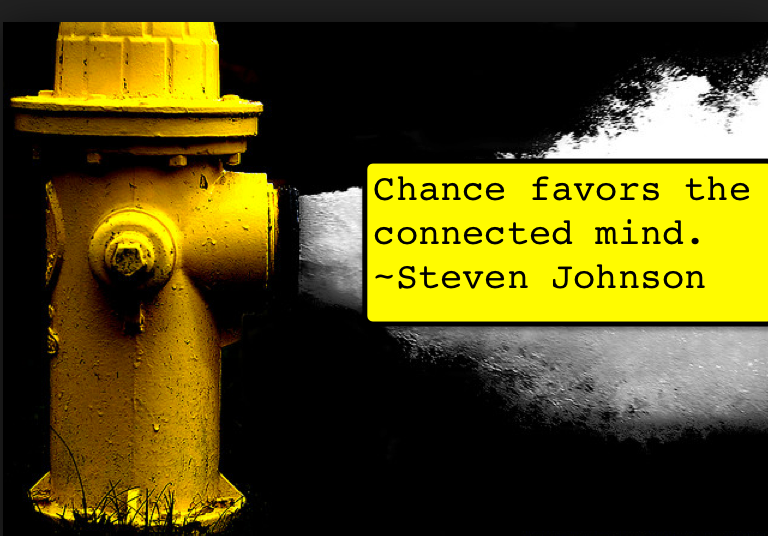
Curation Favors the Connected Mind

Update:  I am ramping up for the fall semester and I find that this post from August 2014 is an apt one for me to review.  Maybe you, too?

Photo by SparkCBC (https://www.flickr.com/photos/25031050@N06/3292307605/) (CC BY-SA 2.0)
Photo by SparkCBC (https://www.flickr.com/photos/25031050@N06/3292307605/)
(CC BY-SA 2.0)

A very interesting and useful blog post on curation and student learning in the context of digital literacy by Ibrar Bhatt.  I have stripped out the parts that were relevant to me and commented below in an attempt to come to terms with curation in my composition classroom.

 “The term [‘curation’] has usually been employed to describe such work which is carried out in museum settings, and has now evolved to describe what is often done in digital environments and online spaces.”

I think it is interesting that we always come back to the idea of digital spaces.  Well, of course we do, but do we ever define what these spaces are?  Is it clear that digital spaces and real world spaces are distinct from each other?

“[P]ractices that people tend to do in “information thick worlds”.
I love this embodied description of information as being thick.  It is also textured and noisy and redolent with smells             and awash in movement and colorful and…tasty.  Three and four dimensional, too.  Like a drama on stage.  Tufte is trying to bridge the gap between digital and real worlds.  It is all one thick informational reality.

 “Select, edit, single out, structure, highlight, group, pair, merge, harmonize, synthesize, focus, organize, condense, reduce, boil down, choose, categorize, catalog, classify, list, abstract, scan, look into, idealize, isolate, discriminate, distinguish, screen, pigeonhole, pick over, sort, integrate, blend, inspect, filter, lump, skip, smooth, chunk, average, approximate, cluster, aggregate, outline, summarize, itemize, review, dip into, flip through, browse, glance into, leaf through, skim, refine, enumerate, glean, synopsize, winnow the wheat from the chaff, and separate the sheep from the goats.”(Tufte, 1990, 50)

Great Tufte quote re-defining curation as an ‘umbrella’ term inclusive of all the skills/verbs he exhaustively lists.  I wonder how useful it is to make the term carry so much freight.

“Anthologising older content to produce new content and creating a new experience for readers, by giving a new life (or new ‘reality’) to an older text. This is curation as a digital literacy practice.”

Ibrar Bhatt’s take on Tufte and on defining digital curation. According to Bhatt, everyday curation includes retweeting, liking, plussing, faving, storifying, patch writing. He contrasts that kind of curation with the exemplary writing of Maria Popova in her blog, Brain Pickings. What does she do that is such a model for others to follow?  She ‘re-contextualizes’ by collecting and interpreting and creating a new experience for the audience with the curated text. Bhatt then  redefines curation as the  “process of problem solving, re-assembling, re-creating, and stewardship of other people’s writing.”

Source: http://www.fastcompany.com/3018236/most-creative-people-2012/51-maria-popova

The image above amounts to a template for curating a digital space:

  1. Find something timeless to curate.
  2. Fit it into a pattern that makes sense.
  3. Find a larger context for why this matters.
  4. Share widely.

I think this fits into Harold Jarche’s simpler seek-sense-share framework.

Why does this matter?  If curation is all that Tufte and Bhatt say it is, then why aren’t scaffolds like these being used more often for training and in learning systems?  I am using the curation tool Scoop.it to do curation with my freshman comp students.  They use Scoop.it as their introductory platform  for beginning to acquire the skills  Tufte enumerates above that are part of the academic and business spaces they will eventually live in.  I am hoping they will demonstrate why it curation matters as they seek-sense-share their way to long and short form ‘texts’ that they will be writing all semester. That will include essays, tweets, G+ community posts, blog posts, research papers, emails, plusses, favs, instagrams, zeegas, slideshares, pictures, and a massive mobile presence from their own digital spaces.  Wish me luck.

Interesting links from article and from comments:

Posted from Diigo. The rest of my favorite links are here.

Update:  I am ramping up for the fall semester and I find that this is an apt post for me to review.  Maybe you, too?