And Hilarity Ensued

Here are two poems below. One was written by me and one was written by an AI:

POEM #1

You cannot remake
the tracks of moles,
pressed once
softly into snow.

No summer storm
will summon twice
the salamanders’
silent crossing.

No sycamore,
felled, replanted,
grows fast enough
to hold again
the heron’s
blue-winged nest.

Give up your breath
instead of these.
Your life,
no more precious
than what lives beyond
your skin.

You,
irreplaceable
only as much
as salamander,
heron,
mole.

Lose one,
lose all.

POEM #2

Mole tracks
in the snow
Salamander migrations
in a summer thunderstorm
Blue heron aeries
in 100’ sycamores over the creek
You could give up
every one of these anomalies
just so long as
You yet live.
All that is adjacent to
that apotheosis
an re-create it
all anew.
All of it.
The prompt? 
At first I asked this:  Compare and reconcile these two poems. Tell me which one is written by an AI.
Answer? No bueno. Google Notebook LM refused to say.
Revised prompt? Speculate as best you can as to which poem was written by an AI.
Answer?  A reluctant one, but at least the AI put a few cards on the table.

Both poems explore the delicate and irreplaceable aspects of the natural world, but they present contrasting perspectives on loss and renewal.

**Comparison:**

* **Shared Imagery:** Both poems utilize the same vivid natural imagery: **mole tracks in the snow, salamander migrations in a summer thunderstorm, and blue heron aeries in 100’ sycamores over the creek**. This shared imagery creates a direct point of comparison and indicates a focus on specific, ephemeral moments in nature.
* **Contrasting Perspectives on Loss:** Source suggests a degree of acceptance of loss, stating, “**You could give up every one of these anomalies yust so long as You yet live**”. It further proposes the possibility to “**re-create it all anew**” as long as life continues. In contrast, Source emphasizes the absolute irreplaceability of these natural occurrences, asserting, “**You cannot remake the tracks of moles, pressed once softly into snow**”. It argues that these specific moments, once gone, are lost forever.
* **Value of Life:** Source implicitly prioritizes human life as the condition for potential renewal. Source explicitly equates the preciousness of human life with that of other living beings and natural phenomena: “**Your life, no more precious than what lives beyond your skin. You, irreplaceable only as much as salamander, heron, mole. Lose one, lose all**”. This highlights a strong sense of interconnectedness and equal value among all forms of life in Source.
* **Tone:** Source has a more resigned yet potentially resilient tone, suggesting an ability to move forward despite loss. Source carries a more urgent and melancholic tone, emphasizing the profound consequences of loss and the finality of vanished natural moments.

**Reconciliation:**

While seemingly contradictory, the poems could be reconciled by considering them as different stages or perspectives on the experience of loss in nature. Source might represent an initial stage of acceptance or a human desire for resilience, suggesting that life continues and adaptation is possible. However, Source provides a deeper ecological understanding, highlighting the irreplaceable nature of specific events and the interconnectedness of life, emphasizing that true loss diminishes the whole system.

One interpretation is that while human life may persist, and some form of “nature” might endure, the specific beauty and interconnectedness embodied in the mole tracks, salamander migrations, and heron nests, as described in Source, are indeed lost forever, and this loss has a profound impact, as suggested by the interconnectedness emphasized in that poem. The act of “giving up” these anomalies, as mentioned in Source, might be possible for individual human survival, but Source suggests that it comes at a cost to the richness and integrity of the living world, ultimately affecting us as well.

**Identifying the AI-written poem:**

Based solely on the provided sources, it is **impossible to definitively determine which poem was written by an AI**. The sources contain only the text of the poems themselves and offer no information about their authorship.

To determine if either poem was written by an AI, one would need additional information about the poems’ origins, such as publication details, author attribution, or analysis of stylistic patterns compared to known AI-generated text. Without such external information, any attempt to identify the AI-written poem would be speculation and not based on the provided sources or our conversation history.


As you can see the AI is a bit of a weasel.  It tries to serve two masters–not to offend the prompter and to answer the  question posed to it. I can only speculate myself here, but I think it knows that the first poem is generated by ChatGPT using this prompt and also using the latest LLM, V4.5. Then I asked it to “explore the adjacent ideas from this poem then write a poem that says the opposite of it.”

BONUS.  If you want to explore this latest LLM, also known as a “vibe” model, take a look at this intriguing tweet as well as the post further on.


https://every.to/napkin-math/the-age-of-vibe-compute

And by the “hilarity” in the title, I mean the night terror of change that is being dreamed up in front of us for the next few years. Nowhere near hilarity.  Don’t even know why I characterized it this way.

Voronoi Diagrams

I have been developing a syllabus for a course in personal futurity.

Here it is.

My personal research project at present is a study of Voronoi diagrams as a way to measure poetic quality.

Here are a few discoveries so far in my preliminary I-Search:

Question #1: What does the following text/poem resemble in a Voronoial diagram where each vowel is one point.

The oscillating

and amplifying

fan of play

having begun

never ends.

Answer #1:  According to ChatGPT this is the Voronoial diagram that is generated.


Question #2: What might these Voronoial diagrams signify for the explication of the poem?

Answer #2:

A Voronoi diagram is a way of dividing space into regions based on distances to a specific set of points. It’s a concept used in computational geometry and has practical applications in fields like geography, biology, and data science. I wish to extend their use to poetic analysis. One of the basic principles of futurity work is to identify what are known as “weak signals” of change.  Jane McGonigal notes that there are ‘trends’ of varying strength:  signals (early stage indicators), patterns (where signals repeat and amplify), or movements (when signals reach critical mass). Another way of thinking about this is to become increasingly aware of  peripheral adjacencies and anomalies.  Using Voronoial Diagrams might be a way to look at quality in a peripheral way.

This is not a lesson in abstraction. It is about a phenomenon that is ubiquitous in nature from the expression of melanin in giraffe spots to the patterns in a garlic cut on the crossection.  It is also a foundational tool in facial recognition, in constructing 3D model for computer animations, and in terrain analysis in GIS analyses.

Key Concepts:

  1. Seed Points:
    • These are the input points, also called “sites,” around which the Voronoi regions are built.
    • Each seed point has a region associated with it.
  2. Voronoi Region:
    • The region associated with a seed point consists of all the locations in the plane that are closer to that seed point than to any other.
    • These regions are convex polygons in 2D space.
  3. Voronoi Edges:
    • The boundaries of the regions, which are equidistant from the nearest two seed points.
    • These are straight lines in 2D but can be more complex in higher dimensions.
  4. Voronoi Vertices:
    • Points where three or more edges meet. These are equidistant from three or more seed points.

How It Works:

  • Imagine dropping a pebble at each seed point and watching the ripples expand outward. Where ripples from different points meet, you draw a boundary. This creates a Voronoi diagram.

Applications:

  1. Geography:
    • Modeling territories (e.g., the closest fire station or hospital for any location).
  2. Biology:
    • Studying patterns like the distribution of cells or animal territories.
  3. Computer Science:
    • Pathfinding, spatial partitioning, and network design.
  4. Art and Design:
    • Generating patterns and textures, or abstract visualizations like the one we created.

Each vowel represents a seed point, and the space is divided into regions based on proximity to those vowels. The visualization highlights how space is partitioned according to these points.

Question #3:  How can this diagram be used to measure the quality of the poem?

Answer #3:

Some might consider that using a Voronoial diagram to measure the “quality” of a poem is an unconventional approach, as it connects spatial geometry to poetic analysis, but recall that what I am also considering how to practice a ‘peripheral vision’ strategy of looking beyond the obvious as I track the anomalies, signals, and adjacencies as they pop up in my morning feldgangs (fieldwalks) and woolgatherings.

So, here’s some ways Voronoial diagrams could be interpreted and used:


1. Spatial Distribution of Vowels:

  • Balanced Distribution: A poem with evenly spaced vowels in its text might produce a more balanced Voronoi diagram, which could metaphorically represent harmony or fluidity in the poem.
  • Clustered Regions: If many vowels cluster together, this might suggest a rhythmic or phonetic density in certain parts of the poem, potentially creating areas of emphasis or intensity.

2. Phonetic Density and Flow:

  • Voronoi regions that vary significantly in size can hint at uneven phonetic patterns. Large regions may correspond to sparse vowel usage, while smaller regions reflect denser phonetic “hotspots.”
  • This could be tied to the poem’s rhythm, cadence, or its visual impact when read aloud.

3. Vowel Richness as a Proxy for Musicality:

  • In poetry, vowels often contribute to euphony (pleasantness of sound) or cacophony (harshness of sound). The Voronoi diagram, when analyzed for patterns of vowel proximity, can highlight areas where the poem’s musicality or harshness is concentrated.

4. Visual Aesthetics and Structure:

  • If the Voronoi diagram is visually pleasing (e.g., symmetrical or balanced), it might resonate with how well the poem feels structured or composed.
  • A chaotic diagram might reflect thematic chaos or tension in the poem, which could be intentional based on the poem’s message.

5. Thematic Connection:

  • A Voronoi diagram can be interpreted metaphorically. For example:
    • A poem about fragmentation or isolation might have sparse, disconnected vowel regions.
    • A poem about unity or connection might exhibit tighter clustering or overlaps.

6. Comparing Multiple Poems:

  • Voronoi diagrams could be used to compare poems, looking for patterns in vowel distributions that correspond to different authors, styles, or themes.
  • A “metric” could be defined based on the distribution, symmetry, or area size variability of the regions.

Practical Example:

For the given poem:

  • Small, tightly packed regions may reflect the intense use of vowels in quick succession, as seen in phrases like “oscillating and amplifying.”
  • Larger, sparse regions could correspond to pauses or moments of reflection, like “never ends.”

By analyzing these features, one could align the diagram with poetic qualities such as rhythm, tone, or mood, enriching the understanding of the poem’s “quality” in a novel way.

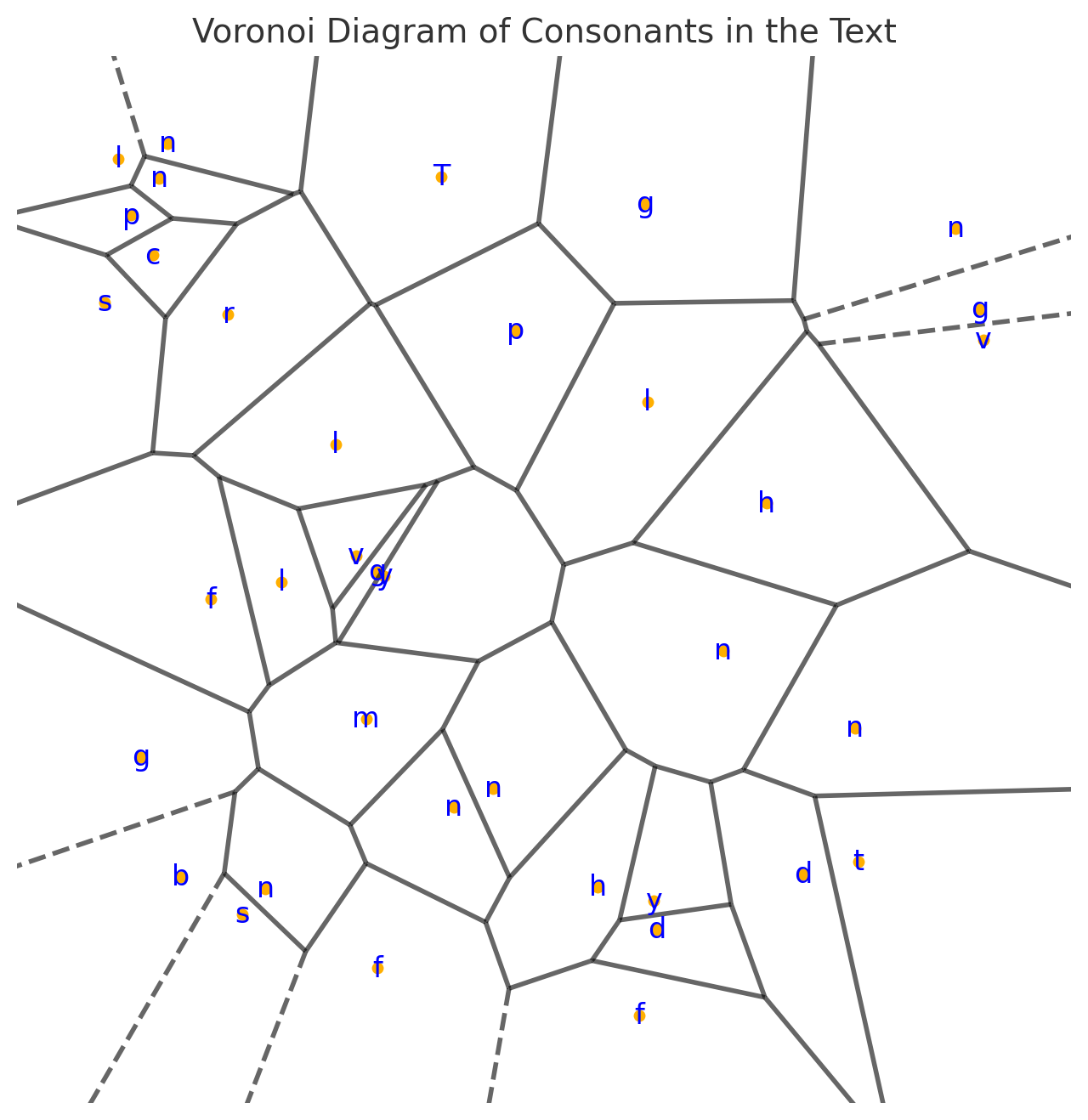
And, of course, this analysis begs the question, “Can consonants be anaylzed in the same way? Yes.


I reckon this is the kind of work that fits retirement very well, n’est-ce pas.

Two Poems Rubbed Together to Stay Warm

Poem #1

One image that keeps rising
in my poetic life,
an inspiration,
is the porch swing at home.
It is the big fat koi in the pond of my imagination.
I continue to roll over the image in my poetry.
That is part of what a poetic life is, a recursion into the glub-glub-glub-speak of my fish unconscious.
And it is also the realization that this game
is not just worth
the candle,
it is the candle.


Poem #2

Fishing
in my remembrance
I realize
this anchor
is way too big.
I tug on it
so I can fish
the next spot.
It won’t let loose.
I can’t pull it up.
Will I be held here forever,
this memory’s
steely grapples
stuck fast
to the chassis
of some ancient
Olds 88
so many fathoms deep?
Stay tuned.